Western Herbalism
Western white clematis
Clematis ligusticifolia
Also known as western virgin's bower, virgin's bower, old man's beard, pepper vine, traveler's joy, creek clematis.
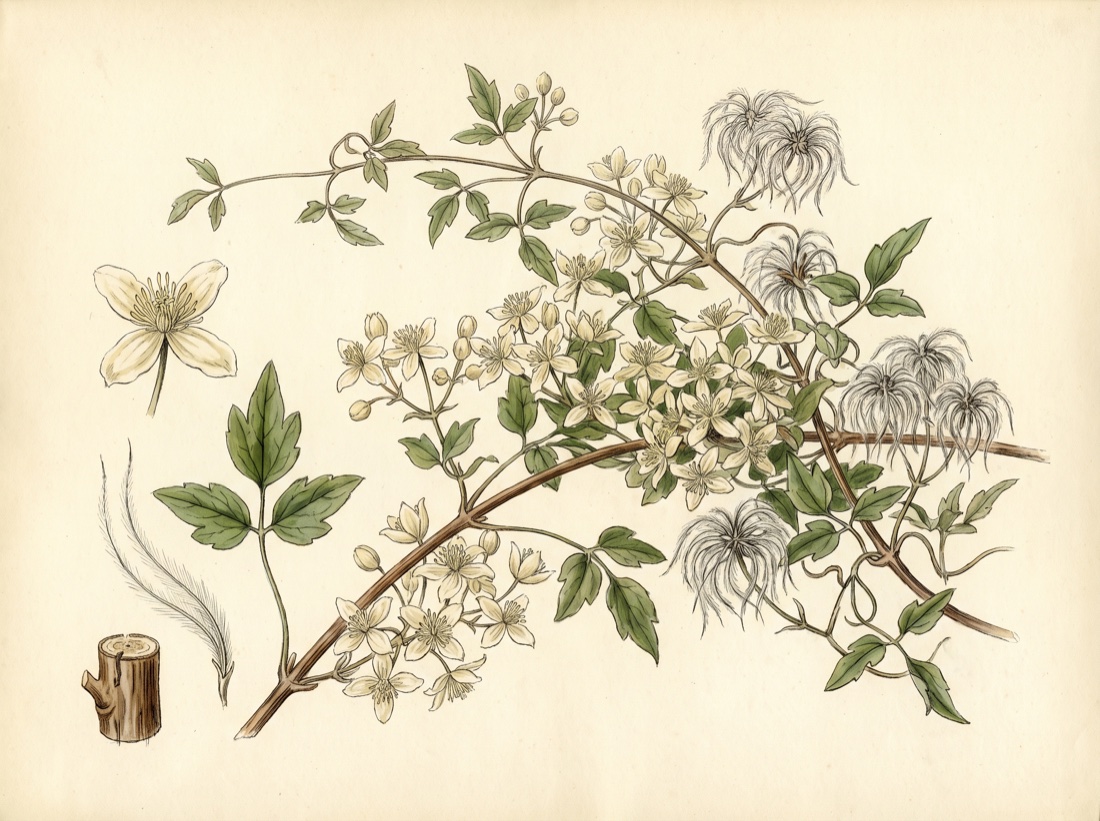
Western white clematis is a vigorous woody vine of streambanks, canyons and fence lines throughout the western United States and Canada, recognizable in late summer by its clouds of small cream flowers and feathery silver seed plumes. Like other members of the buttercup family, the fresh plant contains ranunculin, which releases the blistering irritant protoanemonin when the tissue is crushed. Native peoples and later settlers used it sparingly, chewing a fragment of leaf for colds, sniffing crushed leaves for headache, and washing sores with it. Modern Western herbalists keep it as a low-dose headache remedy and a topical counter-irritant.

Ask Herbert about Western white clematis. Herbert is the master herbalist inside Bountiful Herbs: he answers from this plate and eleven hundred others, with dosing, pairing and cautions. Your first ten questions are free.
Ask HerbertActions
Indications what the tradition reached for it in
- Migraine and vascular headache with a sense of fullness (low dose)
- Tension headache with neck and scalp tightness
- Neuralgia and localized nerve pain (topical)
- Sore, stiff muscles and joints (topical liniment)
- Rheumatic pain, as a brief counter-irritant application
- Sluggish, congested skin eruptions and eczema (dilute wash)
- Colds and sore throat (weak infusion, folk use)
- Sores and saddle sores on horses and livestock (traditional wash)
Specific indications
A dull, congested, throbbing headache that starts at the back of the head or in the temples, in a patient who feels better from cold applications and pressure, dosed in drops of fresh plant tincture
A stiff, aching shoulder or low back where a short-lived warming irritant application is wanted to draw circulation to the area
Safety
Low dose botanical. Used in drop doses in the classical practice; not a plant to dose freely.
Pregnancy: Contraindicated in pregnancy: the fresh plant is an irritant and the family carries a traditional abortifacient reputation, with no safety data.
Breastfeeding: Contraindicated in lactation until more is known; the irritant constituents could pass into milk.
The record lists 10 contraindications; open the plate in the library to read them in full.
In practice
Treat this plant with respect. Its value is in drop doses and brief applications; it should never be given as a routine tea or a full-strength tincture. The classic modern use is a fresh plant tincture in drops for migraine and congestive headaches, often paired with small doses of feverfew, ginger or black cohosh, taken at the first sign of an attack and repeated once or twice.
Dosing as the sources wrote it
| Preparation | As written | Metric |
|---|---|---|
| Fresh plant tincture (1:2, 95%) | 1-10 drops in water up to three times daily | 0.02-0.2 mL |
| Topical fresh leaf | 1 crushed fresh leaf applied to unbroken skin for 2-5 minutes and removed once warmth is felt | |
| Dried leaf wash | 2-4 g dried leaf per 250 mL water as a weak infusion for external use once daily | 2000-4000 mg |
Doses are reproduced from the sources for practitioners and are not a recommendation for any person.
From the sources
Overview. Western white clematis is a vigorous woody vine of streambanks, canyons and fence lines throughout the western United States and Canada, recognizable in late summer by its clouds of small cream flowers and feathery silver seed plumes. Like other members of the buttercup family, the fresh plant contains ranunculin, which releases the blistering irritant protoanemonin when the tissue is crushed. Native peoples and later settlers used it sparingly, chewing a fragment of leaf for colds, sniffing crushed leaves for headache, and washing sores with it. Modern Western herbalists keep it as a low-dose headache remedy and a topical counter-irritant.
Clinical Notes. Treat this plant with respect. Its value is in drop doses and brief applications; it should never be given as a routine tea or a full-strength tincture. The classic modern use is a fresh plant tincture in drops for migraine and congestive headaches, often paired with small doses of feverfew, ginger or black cohosh, taken at the first sign of an attack and repeated once or twice.
Nearby on the shelf
 Water-StarwortCallitriche
 WatercressNasturtium officinale
 WatermelonCitrullus vulgaris
 Welsh onionAllium fistulosum
 Western wormwoodArtemisia ludoviciana
 Wheaten FlourFarina Tritici
 Whistle woodAcer striatum
 White ashFraxinus americana
The whole plate is in the library. The compass, Compare, the Sky of eleven hundred plants and the formulary open with an email address and a password, free, with the formula builder and its safety engine. Herbert without limit, his formulating, clients, the handouts and the labels are the paid room.
Open the library, free