Western Herbalism
Tarragon
Artemisia dracunculus
Also known as French tarragon, Russian tarragon, estragon, dragon's wort, silky wormwood, wild tarragon.
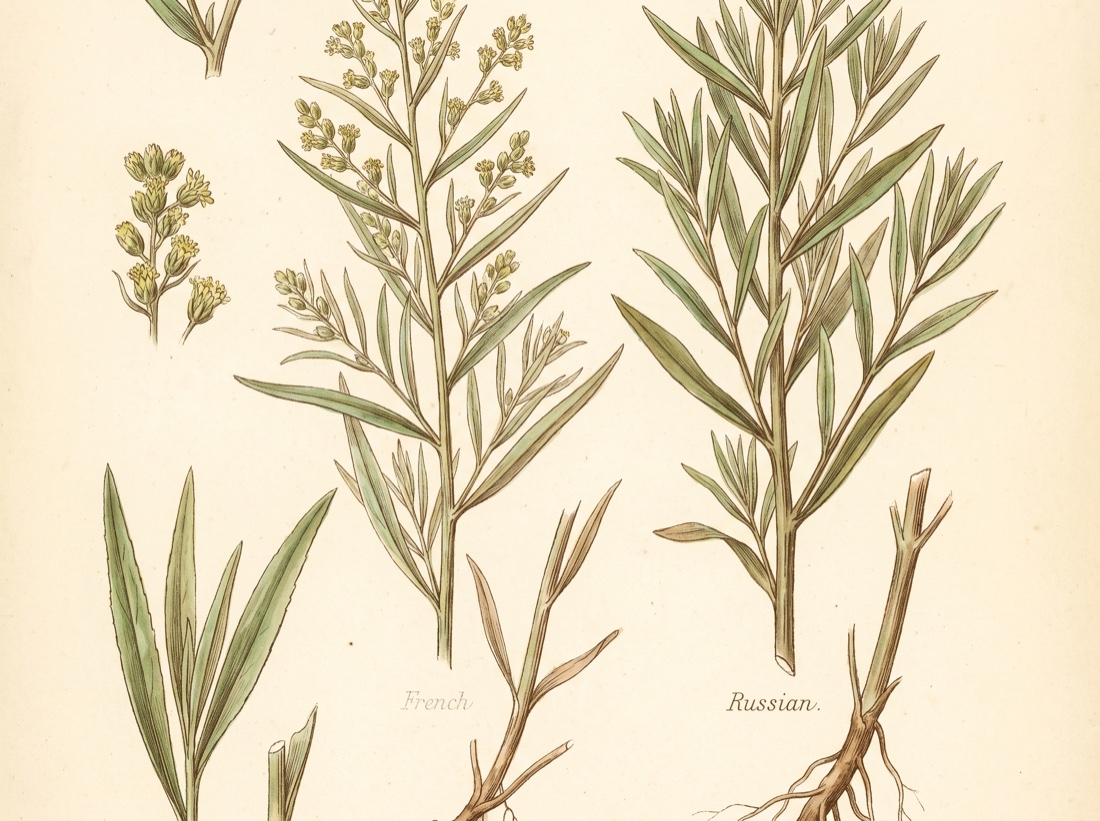
Tarragon is a perennial Artemisia native to temperate Eurasia and western North America. Two forms matter clinically: French tarragon, a sterile, anise-scented culinary clone rich in estragole, and Russian or wild tarragon, a seed-grown, hardier, less aromatic form low in estragole that is the source of the standardized extracts studied for blood sugar. The leaf and flowering tops are used. In Europe it is a kitchen herb with a minor role as a digestive and mild sedative; Central Asian and Persian traditions use it more widely.

Ask Herbert about Tarragon. Herbert is the master herbalist inside Bountiful Herbs: he answers from this plate and eleven hundred others, with dosing, pairing and cautions. Your first ten questions are free.
Ask HerbertActions
Indications what the tradition reached for it in
- Poor appetite and slow digestion
- Flatulent dyspepsia and bloating
- Hiccups and gastric spasm (traditional)
- Insomnia and restlessness (traditional, mild)
- Toothache and mouth pain (chewed leaf, traditional)
- Impaired glucose tolerance and insulin resistance (standardized Russian tarragon extract)
- Delayed or scanty menstruation (traditional)
- Water retention (traditional, mild)
- Intestinal worms (historical)
Specific indications
The prediabetic patient with central weight gain and rising fasting insulin, as an adjunct to diet, using a low-estragole Russian tarragon extract.
A nervous eater with no appetite and a windy stomach who benefits from an aromatic, faintly anise-flavored culinary bitter.
Safety
Low dose botanical. Used in drop doses in the classical practice; not a plant to dose freely.
The record lists 6 contraindications; open the plate in the library to read them in full.
In practice
In the dispensary tarragon is mostly a pleasant carminative and appetite herb: a cup of weak tea or a few drops of tincture before meals for a person who is not hungry, is bloated after eating, or hiccups and belches from gastric spasm.
Dosing as the sources wrote it
| Preparation | As written | Metric |
|---|---|---|
| Infusion | 1-2 g dried aerial parts two or three times daily | 1000-2000 mg |
| Tincture (1:5, 45%) | 2-4 mL three times daily | 2-4 mL |
| Standardized Russian tarragon extract | 1000 mg twice daily with meals | 1000-1000 mg |
Doses are reproduced from the sources for practitioners and are not a recommendation for any person.
From the sources
Overview. Tarragon is a perennial Artemisia native to temperate Eurasia and western North America. Two forms matter clinically: French tarragon, a sterile, anise-scented culinary clone rich in estragole, and Russian or wild tarragon, a seed-grown, hardier, less aromatic form low in estragole that is the source of the standardized extracts studied for blood sugar. The leaf and flowering tops are used. In Europe it is a kitchen herb with a minor role as a digestive and mild sedative; Central Asian and Persian traditions use it more widely.
Clinical Notes. In the dispensary tarragon is mostly a pleasant carminative and appetite herb: a cup of weak tea or a few drops of tincture before meals for a person who is not hungry, is bloated after eating, or hiccups and belches from gastric spasm.
Nearby on the shelf
 TamarindTamarindus indica
 TangerineCitrus reticulata
 TansyTanacetum vulgare
 TapiocaManihot
 Tatarian asterAster tataricus
 Tea treeMelaleuca alternifolia
 TeaselDipsacus fullonum
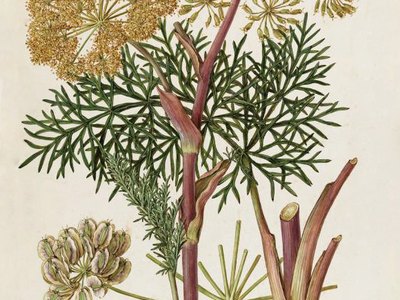 ThapsiaThapsia garganica
The whole plate is in the library. The compass, Compare, the Sky of eleven hundred plants and the formulary open with an email address and a password, free, with the formula builder and its safety engine. Herbert without limit, his formulating, clients, the handouts and the labels are the paid room.
Open the library, free