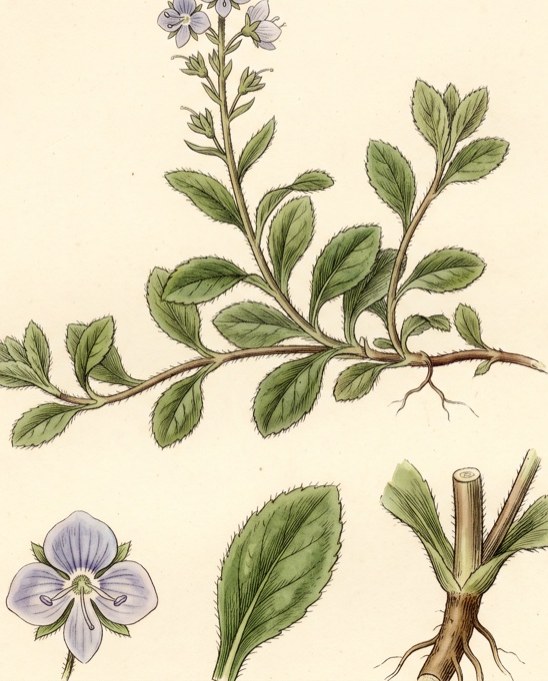
Western Herbalism
Speedwell
Veronica officinalis
Also known as Common speedwell, Heath speedwell, Gypsyweed, Fluellen (regional, England).
Common speedwell is a low, creeping perennial herb native to Europe and naturalized in parts of North America, growing on heaths, dry grassland, and open woodland. The flowering aerial parts are gathered for use, most often as a tea or mild tincture. It held a long-standing place in European folk medicine and was carried into physiomedicalist practice in the United States as a gentle relaxant and diaphoretic alterative, though it was always considered a mild remedy rather than a heroic one.

Ask Herbert about Speedwell. Herbert is the master herbalist inside Bountiful Herbs: he answers from this plate and eleven hundred others, with dosing, pairing and cautions. Your first ten questions are free.
Ask HerbertActions
Indications what the tradition reached for it in
- Chronic or lingering cough
- Catarrh of the upper respiratory tract
- Bronchitis with loose but persistent cough
- Chronic skin eruptions
- Eczema
- Slow-healing minor wounds (topical)
- Rheumatic aches (traditional use)
- Mild urinary complaints
- Liver congestion with sluggishness (traditional, historical)
- Scrofulous swellings (historical use, now largely obsolete indication)
Specific indications
Persistent dry or irritable cough with scanty mucus in a person of generally relaxed, lax tissue tone
Weepy or slow-healing eczema and minor wounds calling for a gentle astringent wash rather than a strong drying agent
Safety
Pregnancy: No safety data exist for use in pregnancy, so avoid or use only under professional guidance given the absence of evidence.
Breastfeeding: No safety data exist for use during lactation, so avoid unless supervised by a qualified practitioner.
The record lists 2 contraindications; open the plate in the library to read them in full.
In practice
Speedwell suits situations calling for a gentle, unforceful remedy rather than a strong intervention: a lingering catarrhal cough in someone whose constitution is already somewhat lax and depleted, or a chronic low-grade skin eruption that needs coaxing rather than aggressive drying.
Dosing as the sources wrote it
| Preparation | As written | Metric |
|---|---|---|
| Infusion (dried aerial parts) | 2-4 g dried herb as tea, up to three times daily | 2000-4000 mg |
| Tincture (1:5, 45%) | 2-4 mL three times daily | 2-4 mL |
| Topical wash or compress | strong infusion applied cool to affected skin, once or twice daily |
Doses are reproduced from the sources for practitioners and are not a recommendation for any person.
From the sources
Overview. Common speedwell is a low, creeping perennial herb native to Europe and naturalized in parts of North America, growing on heaths, dry grassland, and open woodland. The flowering aerial parts are gathered for use, most often as a tea or mild tincture. It held a long-standing place in European folk medicine and was carried into physiomedicalist practice in the United States as a gentle relaxant and diaphoretic alterative, though it was always considered a mild remedy rather than a heroic one.
Clinical Notes. Speedwell suits situations calling for a gentle, unforceful remedy rather than a strong intervention: a lingering catarrhal cough in someone whose constitution is already somewhat lax and depleted, or a chronic low-grade skin eruption that needs coaxing rather than aggressive drying.
Properties and Uses. This herb once had a most fabulous reputation in England as a tonic alterant of relaxing and somewhat diaphoretic powers; and was used in old coughs, pulmonary weakness of all classes, skin diseases, jaundice, affections of the kidneys, and scrofula. While the article certainly has excellent qualities, it is of mild powers; yet it deserves more consideration than has been given to it in this country. Being scarce with us, it is probable that attention might be directed with profit to the more abundant species of the genus. Medical Herbalism journal and medherb.com The Physiomedical Dispensatory by William Cook, M.D., 1869
Description. Natural Order, Scrophulariaceae. The Leptandra Virginica is now placed in the genus Veronica. Stem prostrate, six to twelve inches long, with ascending branches, pubescent. Leaves opposite, an inch or more in length, oval or obovate, serrate. Flowers in racemes from alternate axils, dense with numerous flowers; calyx four-parted; corolla wheel-shaped. Fruit a flattened and notched pod. July. On the Alleghenies. The V. SCUTELLATA resembles the above, and is much more abundant, with few flowers, and growing in bogs throughout the North. All the other species of the speedwell genus are erect, and usually from eight to fifteen inches high. Probably the most of them bear a medical resemblance to the officinalis.
Drawn from Cook's Physio-Medical Dispensatory; King's American Dispensatory, 18th edition (Felter and Lloyd), and the Bountiful Herbs editorial.
Nearby on the shelf
 SouthernwoodArtemisia abrotanum
 Spanish cherryMimusops elengi
 Spanish needlesBidens bipinnata
 SpearmintMentha spicata
 SpicebushBenzoin odoriferum
 Spiked ginger lilyHedychium spicatum
 SpikenardAralia Racemosa
 SpirulinaArthrospira platensis
The whole plate is in the library. The compass, Compare, the Sky of eleven hundred plants and the formulary open with an email address and a password, free, with the formula builder and its safety engine. Herbert without limit, his formulating, clients, the handouts and the labels are the paid room.
Open the library, free