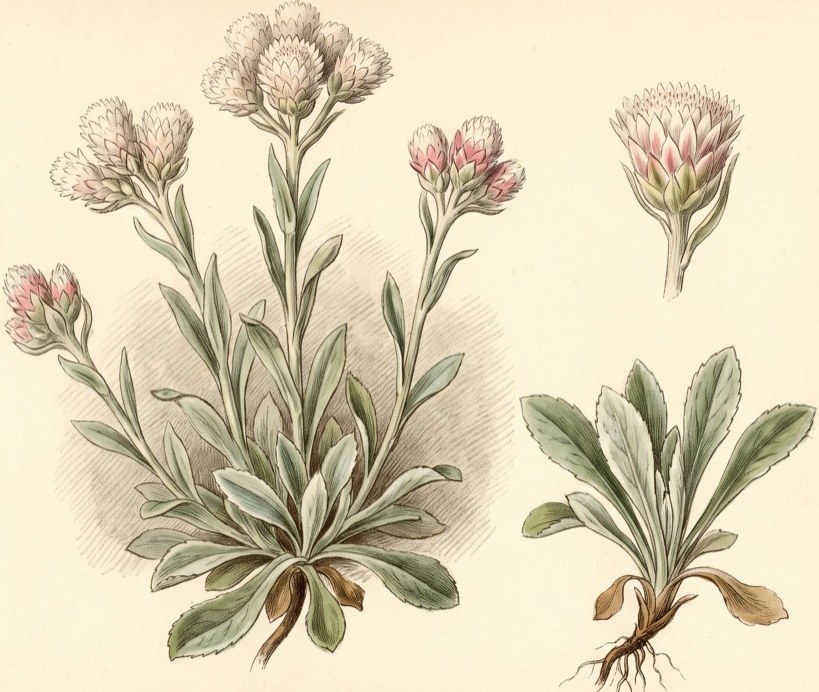
Western Herbalism
Pearly Everlasting
Antennaria
Also known as Pearl-flowered life everlasting, Life everlasting, White balsam.
Pearly everlasting is a hardy, woolly-leaved perennial herb of open fields and dry ground across North America, long confused in old texts with the related pussytoes (Antennaria species) that share its common name. The flowering aerial parts were the part used by the nineteenth century Eclectic physicians, who valued the plant chiefly as a mild astringent for the mouth, throat, and bowel, and as a gentle diaphoretic in fevers. It never became a major materia medica plant but held a small, steady place in folk and Eclectic practice.

Ask Herbert about Pearly Everlasting. Herbert is the master herbalist inside Bountiful Herbs: he answers from this plate and eleven hundred others, with dosing, pairing and cautions. Your first ten questions are free.
Ask HerbertActions
Indications what the tradition reached for it in
- Mouth ulcers
- Sore throat
- Quinsy
- Feverish colds
- Chronic diarrhea
- Leucorrhea
- Bruises and contusions
- Indolent ulcers and swellings
- Mild bronchial catarrh
- Minor hemorrhage
Specific indications
Sore, ulcerated mouth and throat, the fresh leaf chewed and its juice swallowed slowly
Feverish cold or early quinsy where a gentle warm diaphoretic infusion is wanted to bring on sweating
Safety
Pregnancy: Avoid in pregnancy: traditional sources mention effects on the reproductive organs and no modern safety data exist, so it is prudent to avoid internal use.
Breastfeeding: Avoid internal use in lactation due to absence of safety data.
The record lists 2 contraindications; open the plate in the library to read them in full.
In practice
The traditional way of using pearly everlasting for a sore or ulcerated mouth and throat was simple: the fresh leaves and flowers were chewed and the astringent, faintly bitter juice swallowed slowly, or a strong infusion was used as a gargle or mouthwash.
Dosing as the sources wrote it
| Preparation | As written | Metric |
|---|---|---|
| Infusion | 2-4 g dried aerial parts as infusion, three times daily | 2000-4000 mg |
| Tincture (1:5, 40%) | 2-4 mL three times daily | 2-4 mL |
| Topical fomentation | fresh or dried herb, bruised or decocted, applied as a warm compress to bruises or indolent swellings | |
| Action, Medical Uses, and Dosage: Anodyne, astringent, and pectoral. A decoction has proved beneficial in diarrhoea and dysentery, and in pulmonary affections. Externally, it forms an excellent poultice in sprains, bruises, boils, painful swellings, etc., and is said to produce sleep when applied externally to the head, even in cases where a poultice of hops has failed. Rafinesque is authority for the statement that the Indians, for a trifle, would allow rattlesnakes to bite them, to show that they could cure the bite at once with this plant. Decoction (℥j to aqua Oj) freely. |
Doses are reproduced from the sources for practitioners and are not a recommendation for any person.
From the sources
Overview. Pearly everlasting is a hardy, woolly-leaved perennial herb of open fields and dry ground across North America, long confused in old texts with the related pussytoes (Antennaria species) that share its common name. The flowering aerial parts were the part used by the nineteenth century Eclectic physicians, who valued the plant chiefly as a mild astringent for the mouth, throat, and bowel, and as a gentle diaphoretic in fevers. It never became a major materia medica plant but held a small, steady place in folk and Eclectic practice.
Clinical Notes. The traditional way of using pearly everlasting for a sore or ulcerated mouth and throat was simple: the fresh leaves and flowers were chewed and the astringent, faintly bitter juice swallowed slowly, or a strong infusion was used as a gargle or mouthwash.
Action, Medical Uses, and Dosage. Astringent. The leaves and blossoms chewed, and the juice swallowed, have proved beneficial in ulcerations of the mouth and throat. A warm infusion (℥ss to water Oj), may be used in fevers to produce diaphoresis, and is of service in quinsy, pulmonary complaints, leucorrhoea, etc.; it may be used internally and as a local application. Likewise used as an infusion in diseases of the bowels, and hemorrhages, and applied in fomentations to bruises, indolent tumors, and other local affections. Prof. Scudder suggests investigation to determine its influence upon the reproductive and urinary structures, in acute and chronic ulcerations, and in digestive disorders. The fresh juice is reputed an aphrodisiac.
History. White balsam is found in Canada and various parts of the United States, growing in old fields and on dry, barren lands, and bearing whitish-yellow flowers in July and August. The leaves have a pleasant, aromatic smell, and a slightly bitter and astringent, but rather agreeable taste. They yield their properties to water. No analysis has been made of them. The Antennaria Margaritacea, R. Brown, formerly Gnaphalium Margaritaceum, Linné, or pearl-flowered life-everlasting, a perennial plant, possesses similar properties to the above (see Antennaria).
Drawn from King's American Dispensatory, 18th edition (Felter and Lloyd), and the Bountiful Herbs editorial.
Nearby on the shelf
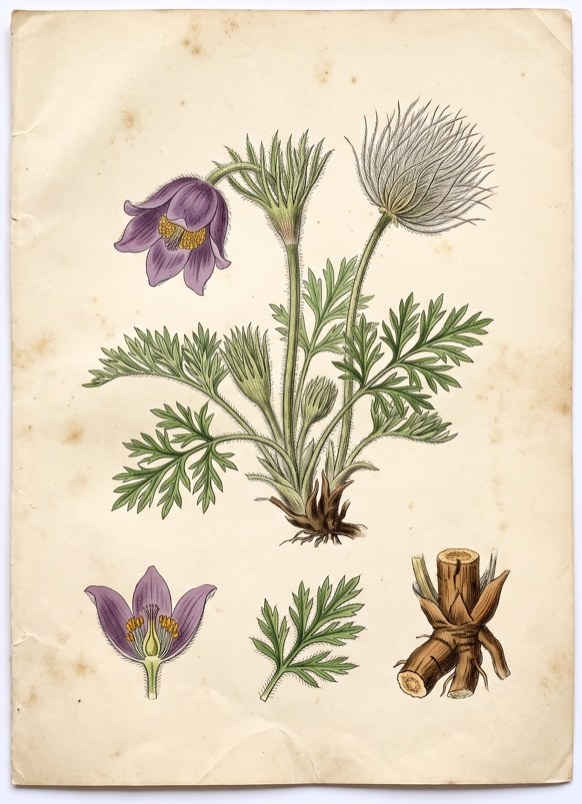 Pasque flowerPulsatilla vulgaris
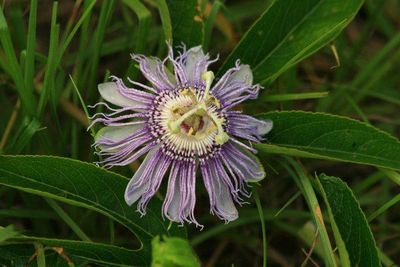 Passion FlowerPassiflora incarnata
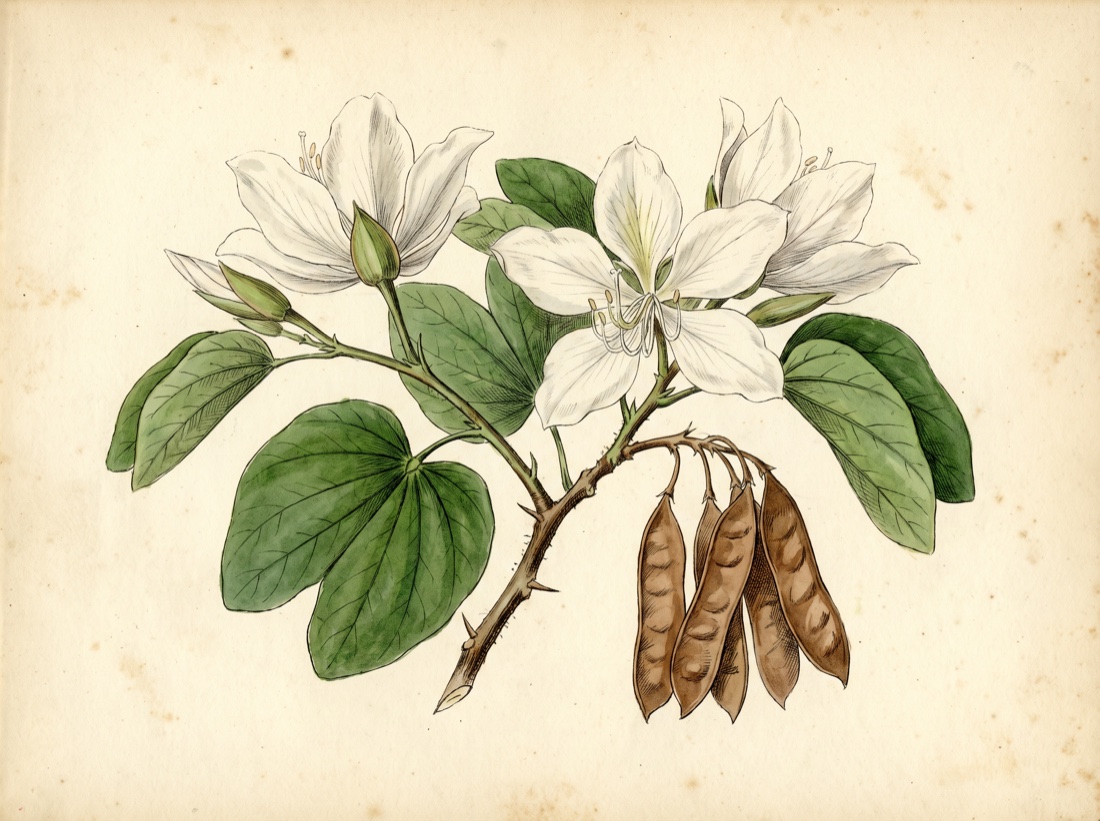 Pata de vacaBauhinia forficata
 PeachPrunus persica
 Peking spurgeEuphorbia pekinensis
 Pellitory of SpainAnthemis pyrethrum
 Pellitory-of-the-WallParietaria officinalis
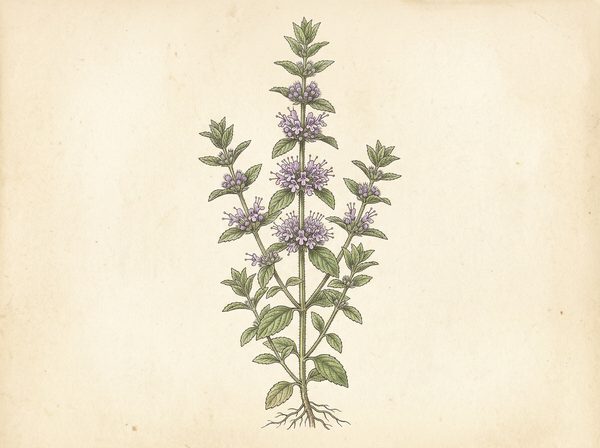 PennyroyalMentha pulegium
The whole plate is in the library. The compass, Compare, the Sky of eleven hundred plants and the formulary open with an email address and a password, free, with the formula builder and its safety engine. Herbert without limit, his formulating, clients, the handouts and the labels are the paid room.
Open the library, free