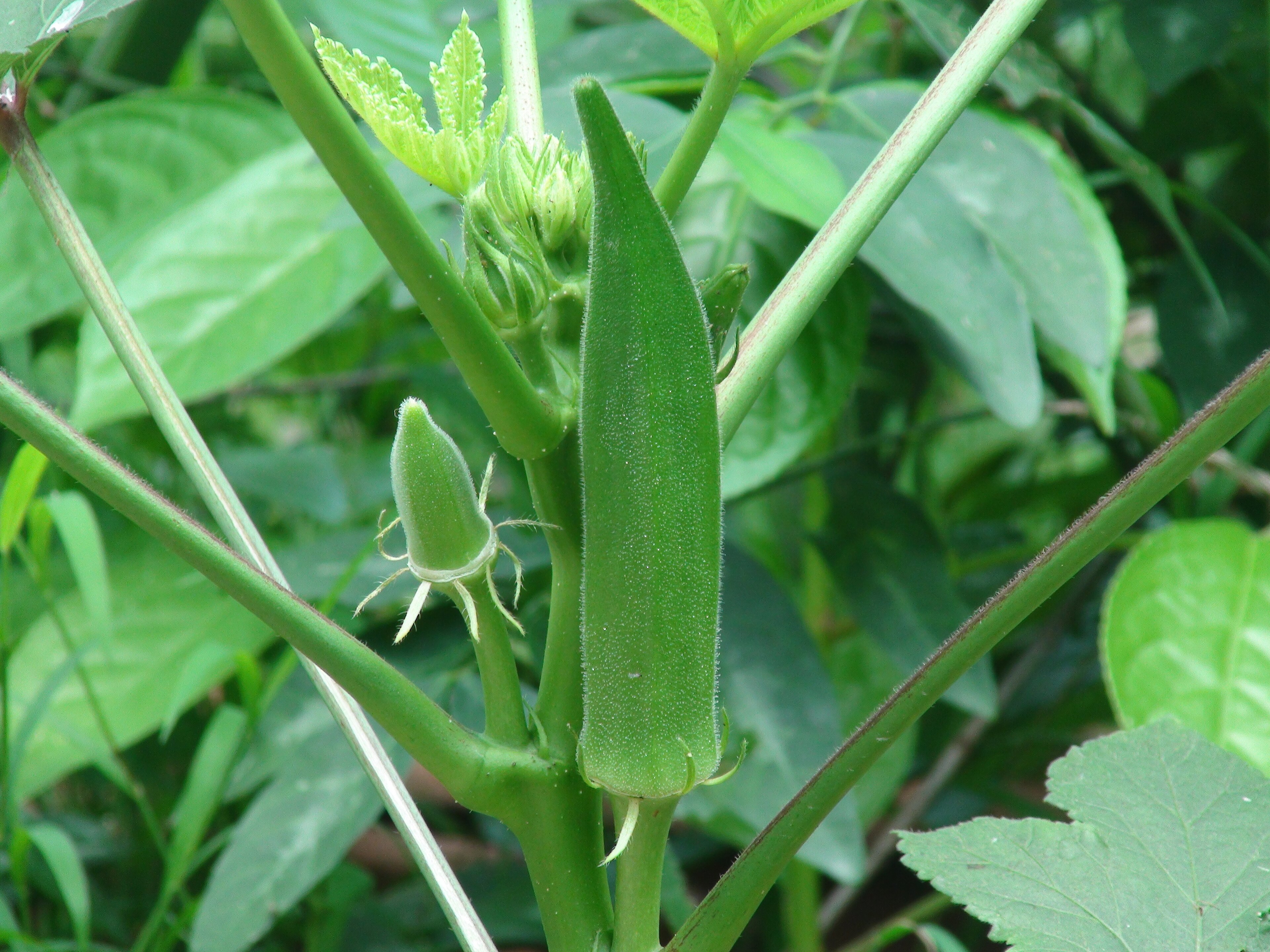
Western Herbalism
Okra
Hibiscus Esculentus
Also known as Gombo, Bendee, Lady's fingers.
Okra is a warm-season annual of the mallow family, cultivated across Africa, the Middle East, South Asia, and the Americas for its edible immature seed pods. The pods contain an abundant soluble mucilage that has long been valued in folk and eclectic practice as a gentle demulcent. Eclectic physicians of the nineteenth century used a simple decoction of the fresh or dried pods to soothe irritated mucous membranes of the throat, stomach, bowel, and urinary tract, and the plant remains primarily a food with secondary medicinal use.

Ask Herbert about Okra. Herbert is the master herbalist inside Bountiful Herbs: he answers from this plate and eleven hundred others, with dosing, pairing and cautions. Your first ten questions are free.
Ask HerbertActions
Indications what the tradition reached for it in
- Dysentery
- Irritative diarrhea
- Sore throat
- Dry cough with irritated throat
- Urinary tract irritation
- Gastric irritation and dyspepsia
- Constipation
- Convalescent or debility nutrition
- Adjunct support in early type 2 diabetes
Specific indications
Dry, burning irritation of throat or gut mucosa that is eased by a soothing mucilaginous drink
Postprandial blood sugar spikes in early, diet-managed type 2 diabetes where a mucilage-rich food adjunct is wanted
Safety
The record lists 3 contraindications; open the plate in the library to read them in full.
In practice
Okra is reached for less as a potent remedy and more as a food-based demulcent, useful where a patient needs something soothing and nourishing rather than strongly medicinal. A simple preparation is to slice fresh or dried pods and simmer gently in water for ten to fifteen minutes, then strain and drink the mucilaginous liquid warm for sore throat, dry irritable cough, or a hot, irritated gut with loose stool.
Dosing as the sources wrote it
| Preparation | As written | Metric |
|---|---|---|
| Pod decoction (mucilage tea) | 1-2 fresh or dried pods, sliced, simmered in 250 mL water for 10-15 minutes, drunk warm 2-3 times daily | 1-250 mL |
| Dietary use | 100-200 g cooked pods daily as a food-based adjunct | 100000-200000 mg |
Doses are reproduced from the sources for practitioners and are not a recommendation for any person.
From the sources
Overview. Okra is a warm-season annual of the mallow family, cultivated across Africa, the Middle East, South Asia, and the Americas for its edible immature seed pods. The pods contain an abundant soluble mucilage that has long been valued in folk and eclectic practice as a gentle demulcent. Eclectic physicians of the nineteenth century used a simple decoction of the fresh or dried pods to soothe irritated mucous membranes of the throat, stomach, bowel, and urinary tract, and the plant remains primarily a food with secondary medicinal use.
Clinical Notes. Okra is reached for less as a potent remedy and more as a food-based demulcent, useful where a patient needs something soothing and nourishing rather than strongly medicinal. A simple preparation is to slice fresh or dried pods and simmer gently in water for ten to fifteen minutes, then strain and drink the mucilaginous liquid warm for sore throat, dry irritable cough, or a hot, irritated gut with loose stool.
Properties and Uses. I. The capsules abound in an agreeable mucilage, which is used as an aliment in broths and soups. An infusion is grateful in dysentery and diarrhea; in acute inflammation and irritation of the stomach, bowels, and kidneys; and during the existence of a glassy tongue in typhoid cases.
Description. Natural Order, Malvaceae. Formerly in the genus Hibiscus. Genus ABELMOSCHUS : Calyx five-toothed, spathe-like; involucre five to ten leaved. Fruit a five-celled capsule, opening by five valves. A. ESCULENTUS : An annual, with erect stems from three to four feet high, branched, woody toward the base, tender parts covered with bristles and often purple-spotted.
Drawn from Cook's Physio-Medical Dispensatory; King's American Dispensatory, 18th edition (Felter and Lloyd), and the Bountiful Herbs editorial.
Nearby on the shelf
 Nux VomicaStrychnos nux-vomica
 OatAvena sativa
 Ochroleucous gentianGentiana Ochroleuca
 OcotilloFouquieria splendens
 Old man's beardUsnea spp.
 OleanderOleander
 OliveOlea europaea
 OnionAllium cepa
The whole plate is in the library. The compass, Compare, the Sky of eleven hundred plants and the formulary open with an email address and a password, free, with the formula builder and its safety engine. Herbert without limit, his formulating, clients, the handouts and the labels are the paid room.
Open the library, free