Ayurvedic Herbalism
Kokum
Garcinia indica
Also known as kokam, Goa butter tree, mangosteen oil tree, wild mangosteen, Vrikshamla, Amlabija, Tintidika.
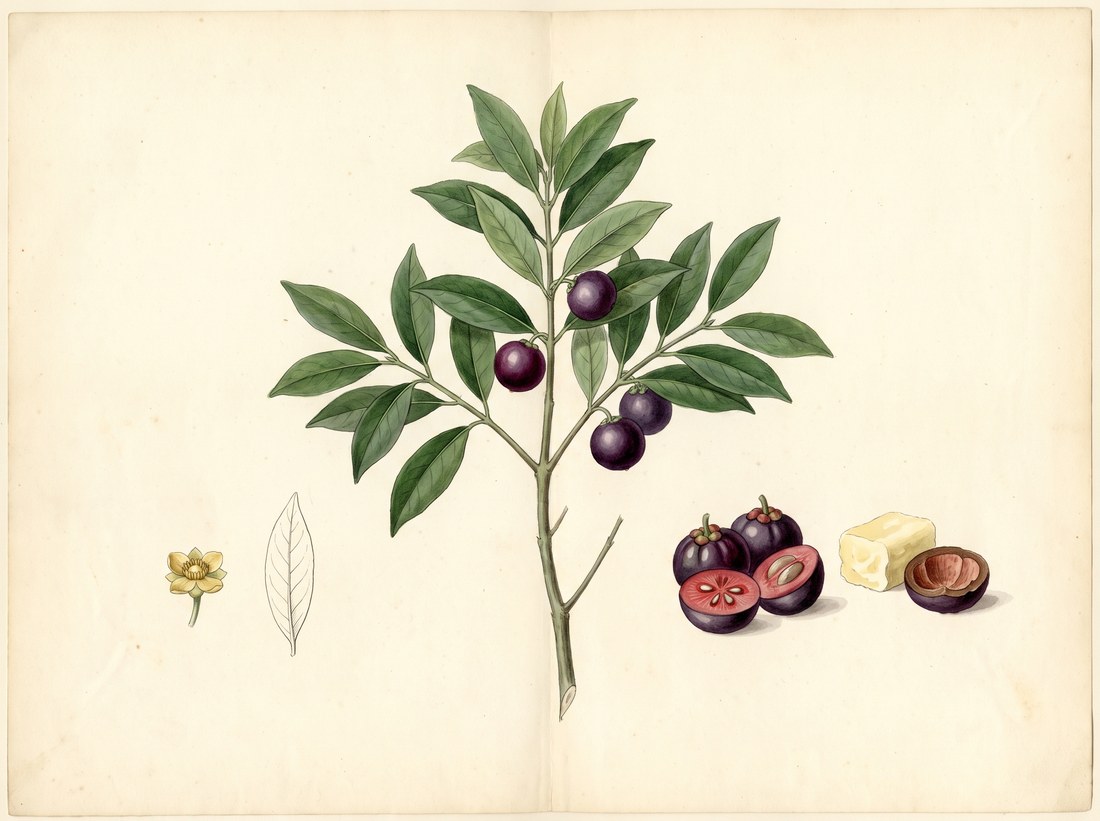
Garcinia indica is the kokum tree, a slender evergreen of the mangosteen family native to the Western Ghats of Maharashtra, Goa, Karnataka and Kerala, where it grows in the wet coastal forests and is cultivated around homesteads. The dark purple fruit is the source of the sun-dried sour rind used to season Konkani and Goan cooking and to make a cooling sherbet, and the seed yields a firm white butter. Ayurveda knows it as Vrikshamla, a sour digestive and mild binding agent, and values the seed fat as an emollient for cracked skin.

Ask Herbert about Kokum. Herbert is the master herbalist inside Bountiful Herbs: he answers from this plate and eleven hundred others, with dosing, pairing and cautions. Your first ten questions are free.
Ask HerbertActions
Indications what the tradition reached for it in
- Sluggish digestion with bloating and gas
- Loss of appetite and poor taste
- Mild diarrhea and dysentery
- Hemorrhoids with constipation
- Heat exhaustion and thirst in summer (diluted sherbet)
- Cracked heels, chapped lips and dry eczema (seed butter)
- Weight management as a food adjunct
- Acid dyspepsia with kapha heaviness
- Minor skin infections and ulcers (butter as base)
- Elevated lipids as a dietary sour agent (traditional)
Specific indications
A heavy, damp kapha eater with slow digestion, gas and poor appetite who would do better with a sour digestive than a hot pungent one
A hot, thirsty patient in high summer with sweating, weakness and loss of appetite, given the diluted rind sherbet rather than the concentrated rind
Painful cracked heels and dry, fissured lips in a vata patient that need a solid, slow-melting fat rather than a thin oil
Hemorrhoids with a tendency to loose stool where a mild astringent sour agent is wanted alongside the meal
Safety
The record lists 5 contraindications; open the plate in the library to read them in full.
In practice
In Ayurvedic practice Vrikshamla is a food-medicine rather than a strong drug. The rind is added to dal, fish curry and lentil dishes as a sour agent for patients with weak agni and kapha heaviness, in place of tamarind, which is heavier and more aggravating to kapha.
In Ayurveda
Rasa: amla (sour), madhura (sweet, ripe fruit). Virya: ushna (heating) by classical description, though the diluted rind sherbet is used in folk practice as a cooling summer drink. Vipaka: amla (sour). Guna: laghu (light), ruksha (dry). Dosha: pacifies vata and kapha; may aggravate pitta in excess, particularly the concentrated rind. Karma: deepana (kindles digestion); pachana (digestive); rochana (improves taste and appetite); hridya (cardiac tonic); grahi (binds the stool); anulomana (regulates downward movement); trishnanigrahana (quenches thirst, diluted sherbet); vatakaphahara (reduces vata and kapha); snehana (unctuous, external, seed butter). Classical indications: arsha (hemorrhoids); gulma (abdominal mass and bloating); hridroga (heart disorders); agnimandya (weak digestion); arochaka (loss of appetite); atisara (diarrhea); udavarta (upward moving vata with constipation); trishna (thirst); sphutita pada (cracked heels, seed butter); sthaulya (obesity, modern extension). The dried fruit rind is the drug and the kitchen souring agent, taken as kwatha, as a diluted cold infusion or sherbet, or as churna with food. The seed butter (kokum ghrita) is a solid vegetable fat applied to cracked skin, lips and heels and used as a base for ointments and suppositories. Classical formulations: Vrikshamla kwatha, Kokum sherbet (Amrit kokum), Kokum butter ointment, Vrikshamla churna. Described in: Bhavaprakasha Nighantu, Raja Nighantu.
Dosing as the sources wrote it
| Preparation | As written | Metric |
|---|---|---|
| Churna (rind) | 3-6 g powdered dried rind before meals with warm water | 3000-6000 mg |
| Kwatha (rind) | 50-100 mL decoction twice daily | 50-100 mL |
| Sherbet (diluted rind infusion) | 100-200 mL diluted rind infusion once or twice daily in hot weather | 100-200 mL |
| Seed butter, topical | 2-5 g kokum butter applied to cracked skin at bedtime | 2000-5000 mg |
Doses are reproduced from the sources for practitioners and are not a recommendation for any person.
From the sources
Overview. Garcinia indica is the kokum tree, a slender evergreen of the mangosteen family native to the Western Ghats of Maharashtra, Goa, Karnataka and Kerala, where it grows in the wet coastal forests and is cultivated around homesteads. The dark purple fruit is the source of the sun-dried sour rind used to season Konkani and Goan cooking and to make a cooling sherbet, and the seed yields a firm white butter. Ayurveda knows it as Vrikshamla, a sour digestive and mild binding agent, and values the seed fat as an emollient for cracked skin.
Clinical Notes. In Ayurvedic practice Vrikshamla is a food-medicine rather than a strong drug. The rind is added to dal, fish curry and lentil dishes as a sour agent for patients with weak agni and kapha heaviness, in place of tamarind, which is heavier and more aggravating to kapha.
Ayurvedic Profile. Rasa: amla (sour), madhura (sweet, ripe fruit). Virya: ushna (heating) by classical description, though the diluted rind sherbet is used in folk practice as a cooling summer drink. Vipaka: amla (sour).
Nearby on the shelf
 KinoPterocarpus marsupium
 Klip daggaLeonotis nepetifolia
 KnotgrassPolygonum aviculare
 KochiaBassia scoparia
 Kola NutCola acuminata
 KonjacAmorphophallus konjac
 Korean MintAgastache rugosa
 Korean pinePinus koraiensis
The whole plate is in the library. The compass, Compare, the Sky of eleven hundred plants and the formulary open with an email address and a password, free, with the formula builder and its safety engine. Herbert without limit, his formulating, clients, the handouts and the labels are the paid room.
Open the library, free