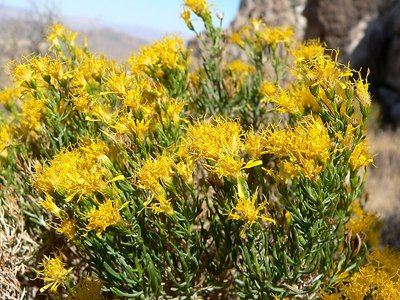
Western Herbalism
Haplopappus
Haplopappus laricifolius
Also known as Turpentine bush, Larchleaf goldenweed, Yerba del Pasmo, Herba del Pasmo, Ericameria laricifolia.
Haplopappus laricifolius, now classified as Ericameria laricifolia, is a small resinous, aromatic shrub with narrow needle-like leaves resembling larch, native to the desert Southwest of the United States and northern Mexico. It was known to Mexican and Spanish-speaking communities of the region as yerba del pasmo, an herb reserved for spasm and convulsive illness, and was picked up by nineteenth-century eclectic physicians who reported striking, if largely anecdotal, results in tetanus and other convulsive disorders. It has never entered mainstream modern herbal practice and remains almost entirely undocumented by contemporary pharmacological research.

Ask Herbert about Haplopappus. Herbert is the master herbalist inside Bountiful Herbs: he answers from this plate and eleven hundred others, with dosing, pairing and cautions. Your first ten questions are free.
Ask HerbertActions
Indications what the tradition reached for it in
- Tetanus (traditional and historical use only)
- Puerperal convulsions (historical)
- Childhood convulsions of various causes (historical)
- Epileptic seizure disorder (historical, unverified)
- Chorea (historical)
- Hysterical spasm (older terminology for convulsive nervous states)
- Meningeal spasm and rigidity (historical)
- Generalized muscle spasm and cramping
- Minor wounds and rheumatic pain (traditional topical use)
Specific indications
Persistent, treatment-resistant muscle spasm or convulsive tendency where standard antispasmodics have failed, per older eclectic case reports
Traditional Mexican and Southwestern U.S. folk use for tetanus, historically given freely and reported to be well tolerated, always alongside modern emergency medical care
Safety
Pregnancy: Avoid in pregnancy: historical use in labor and puerperal convulsions suggests possible uterine activity, and no modern reproductive safety data exist.
Breastfeeding: Avoid during lactation given the complete absence of modern safety data.
The record lists 5 contraindications; open the plate in the library to read them in full.
In practice
This plant survives in the record mainly as a curiosity of eclectic medicine. Writers such as Webster described dramatic responses in tetanus and puerperal, hysterical, and epileptic convulsions, with the herb said to be given liberally and without apparent harm in regions where the folk tradition was strong.
Dosing as the sources wrote it
| Preparation | As written | Metric |
|---|---|---|
| Infusion | 1-2 g dried aerial parts as infusion, traditional dose, not well established | 1000-2000 mg |
| Tincture (1:5) | 0.5-2 mL up to three times daily, traditional dose, not well established | 0.5-2 mL |
Doses are reproduced from the sources for practitioners and are not a recommendation for any person.
From the sources
Overview. Haplopappus laricifolius, now classified as Ericameria laricifolia, is a small resinous, aromatic shrub with narrow needle-like leaves resembling larch, native to the desert Southwest of the United States and northern Mexico. It was known to Mexican and Spanish-speaking communities of the region as yerba del pasmo, an herb reserved for spasm and convulsive illness, and was picked up by nineteenth-century eclectic physicians who reported striking, if largely anecdotal, results in tetanus and other convulsive disorders. It has never entered mainstream modern herbal practice and remains almost entirely undocumented by contemporary pharmacological research.
Clinical Notes. This plant survives in the record mainly as a curiosity of eclectic medicine. Writers such as Webster described dramatic responses in tetanus and puerperal, hysterical, and epileptic convulsions, with the herb said to be given liberally and without apparent harm in regions where the folk tradition was strong.
LOCALITY. Texas, New Mexico, Arizona, California and Northern Mexico. This may be closely related to damiana. We insert it here, that it may be kept before the minds of our readers until its properties are determined.
Drawn from Ellingwood's American Materia Medica, Therapeutics and Pharmacognosy, and the Bountiful Herbs editorial.
Nearby on the shelf
 Hair-cap mossPolytrichum juniperum
 Hairy figFicus hispida
 Hairy Monkey-FlowerMimulus
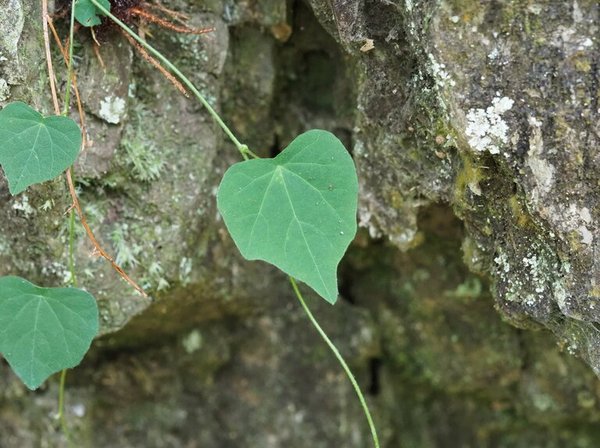 Han Fang JiStephania tetrandra
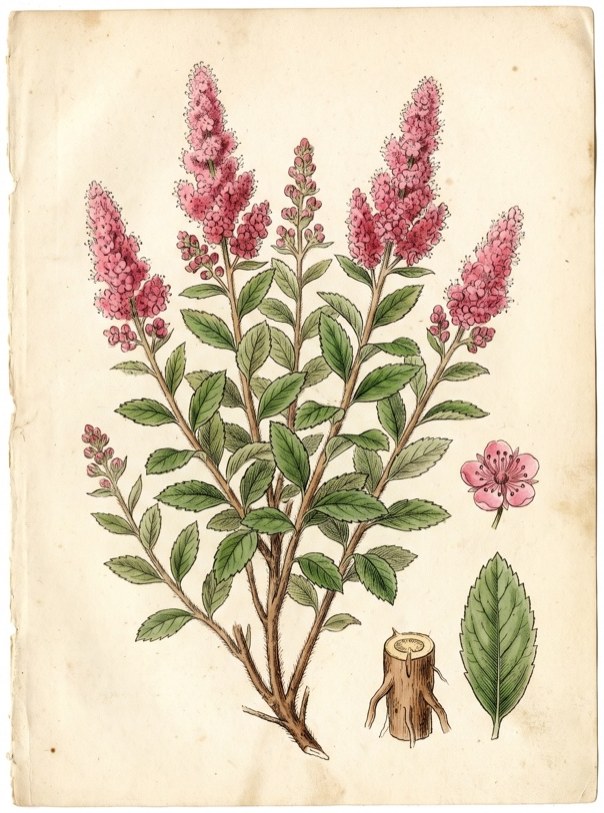 HardhackSpirea tomentosa
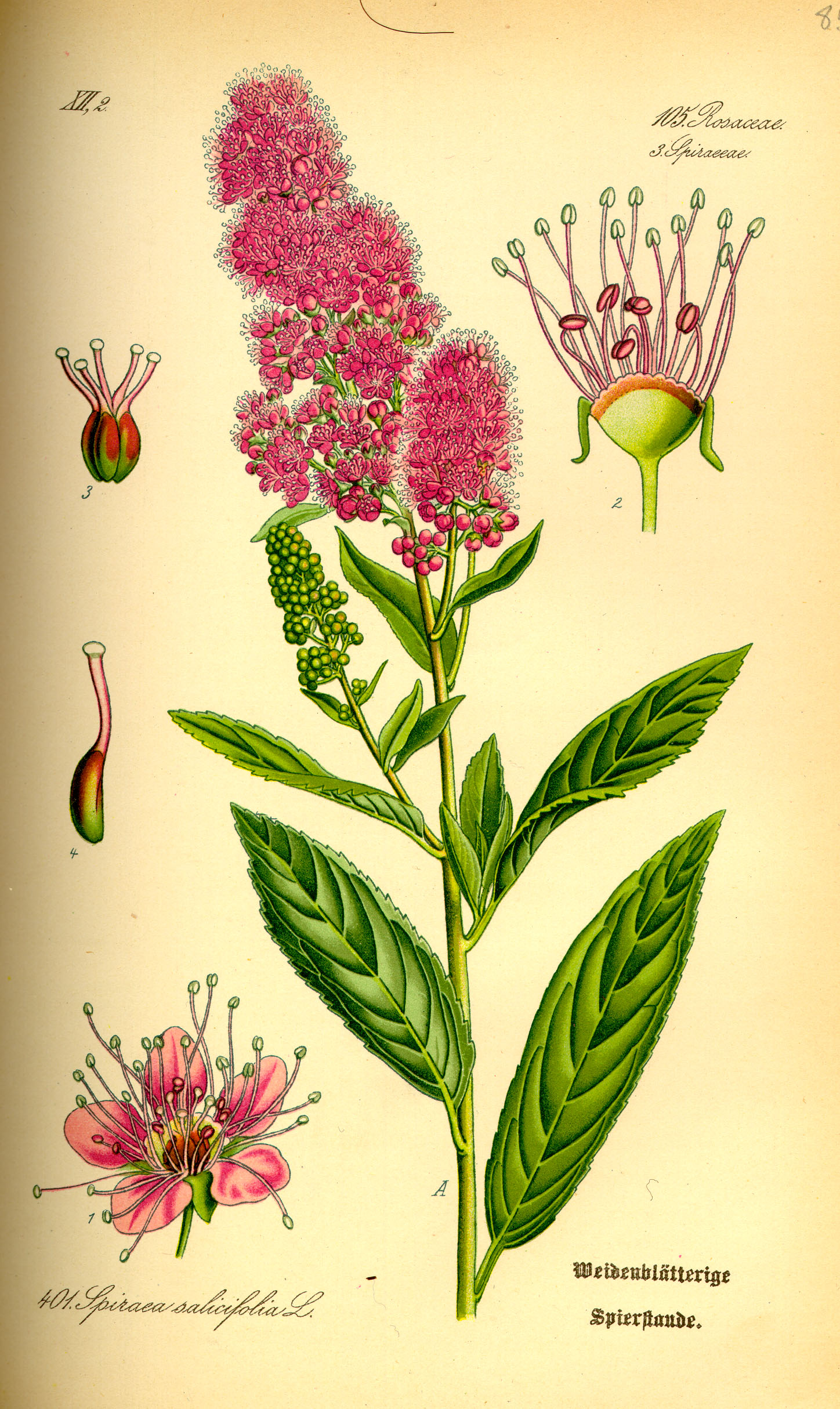 HardhackSpiraea
 HawkweedHieracium venosum
 HawthornCrataegus oxyacantha
The whole plate is in the library. The compass, Compare, the Sky of eleven hundred plants and the formulary open with an email address and a password, free, with the formula builder and its safety engine. Herbert without limit, his formulating, clients, the handouts and the labels are the paid room.
Open the library, free