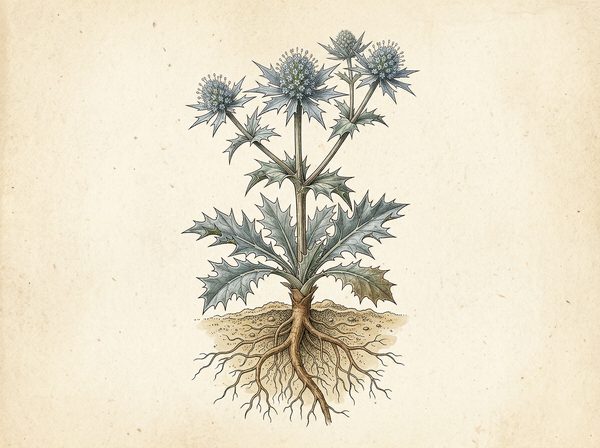
Western Herbalism
Eryngo
Eryngium maritimum
Also known as Sea Holly, Water Eryngo, Button Snakeroot, Rattlesnake's Master, Corn Snakeroot, Buttonsnake root.
Traditional use as restorative and aphrodisiac Candied roots historically used Limited clinical evidence, mostly traditional and in vitro pharmacological support

Ask Herbert about Eryngo. Herbert is the master herbalist inside Bountiful Herbs: he answers from this plate and eleven hundred others, with dosing, pairing and cautions. Your first ten questions are free.
Ask HerbertActions
Indications what the tradition reached for it in
- Liver obstructions
- Delirium
- Swollen breathing passages
- Poison
- Kidney weakness
- Lower back weakness
- Bone weakness
- Scorbutic complaints
- Rheumatism
- Chronic nervous diseases
- Bronchitis
- Debility
- Quartan fever
- Paralysis
- Chronic coughs
- Epilepsy
- Urinary tract infection
- Delayed menstruation
- Venomous bite
- Joint weakness
- Menstrual cramps
- Cough
- Cystitis
- Insomnia
- Jaundice
- Irregular menstruation
- Obstructed menstruation
- Fright
- Spasms
- Chronic arthritis
Safety
Pregnancy: Pregnancy Caution
Breastfeeding: Lactation (source flag notSafeInLactation)
The record lists 2 contraindications; open the plate in the library to read them in full.
Dosing as the sources wrote it
| Preparation | As written | Metric |
|---|---|---|
| Dose, 10 to 40 grains. | 648-2592 mg | |
| Dose, 5 to 40 drops. | 0.1-0.8 mL | |
| The pulverized root, in doses of 2 or 3 grains, has proved very effectual in hemorrhoids and prolapsus ani. | 194-194 mg | |
| Two ounces of the pulverized root, added to 1 pint of good Holland gin, has effected cures in obstinate cases of gonorrhoea and gleet; to be administered in doses of 1 or 2 fluid drachms 3 or 4 times a day. | 473 mL | |
| powder | Dose of the powder, from 20 to 40 grains; of the decoction, which was formerly principally used, from 2 to 4 fluid ounces, several times daily. | 1296-2592 mg |
| The best preparation is specific eryngium, the dose of which may range from 1 to 20 drops, administered in water. | 0.05-1 mL |
Doses are reproduced from the sources for practitioners and are not a recommendation for any person.
From the sources
Clinical Notes. Traditional use as restorative and aphrodisiac Candied roots historically used Limited clinical evidence, mostly traditional and in vitro pharmacological support
Action and Therapy. The root of eryngium, when chewed, causes a profuse flow of saliva; in large doses it is emetic. Its chief properties are those of a diuretic and expectorant. While of considerable value in chronic laryngitis and bronchitis with free and abundant secretion of muco-pus, it is of most service in irritation of the bladder and urethra, with itching, burning, and constant urging to urinate.
primary-actions. Eryngo acts primarily as: Diuretic, Expectorant, Stimulant, Diaphoretic, Aphrodisiac, Nephroprotective, Nervine. Secondary actions include Aromatic, Nutritive, Restorative, Expectorant.
Specific Indications. Burning pain, with renal, vesical or urethral irritability; painful micturition, with frequent urging to urinate; frequent, scanty and scalding urination; scanty urine, with frequent and ineffectual attempts to urinate; deep-seated pain in bladder extending into the loins; profuse mucous discharges.
Drawn from King's American Dispensatory, 18th edition (Felter and Lloyd); Felter's Eclectic Materia Medica, Pharmacology and Therapeutics, and the Bountiful Herbs editorial.
Nearby on the shelf
 EpigaeaEpigaea repens
 EquisetumEquisetum hyemale
 ErgotSecale Cornutum
 EryngiumEryngium aquaticum
 EucalyptusEucalyptus globulus
 European CranberryVaccinium macrocarpon
 European LarchLarix decidua
 European mistletoeViscum album
The whole plate is in the library. The compass, Compare, the Sky of eleven hundred plants and the formulary open with an email address and a password, free, with the formula builder and its safety engine. Herbert without limit, his formulating, clients, the handouts and the labels are the paid room.
Open the library, free