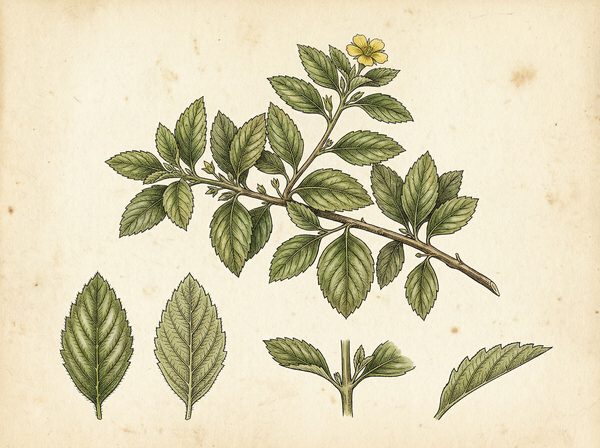
Western Herbalism
Damiana
Turnera diffusa
Also known as Turnera diffusa.
Effectiveness not sufficiently documented per (ABC) traditionally used as aphrodisiac, tonic, nerve tonic in Mexican folk medicine contains cyanogenic glycoside but no toxicity reports at standard doses

Ask Herbert about Damiana. Herbert is the master herbalist inside Bountiful Herbs: he answers from this plate and eleven hundred others, with dosing, pairing and cautions. Your first ten questions are free.
Ask HerbertActions
Indications what the tradition reached for it in
- Sexual impotence
- Nervous dyspepsia
- Anxiety neurosis with impotency
- Gastrointestinal diseases
- Coital inadequacy
- Sexual debility
- Nervous exhaustion
- Stress
- Nervous prostration
- Respiratory disease
- Reproductive organ disorders
- Gonorrhea
- Depression
- Nervous tension
- Atonic constipation
- Anxiety
- Constipation
- Debility
- Edema
- Fatigue
- Fluid retention
- Urinary disorders
- Weakness
- Low libido
- Sexual dysfunction
- Lethargy
- Specifically for anxiety neurosis with a predominant sexual factor
- Sexual dysfunction or decreased libido
- Diabetes
Safety
Pregnancy: Not safe. Not for use in pregnancy (our record's flag)
Pregnancy, our record's flag: Caution. Use with care in pregnancy (our record's flag)
Pregnancy, a modern clinical reference: The safety of damiana has not been established
Pregnancy, a modern clinical reference: Safety in pregnancy has not been scientifically evaluated however no increase in fetal abnormalities has been observed from limited use in women
Pregnancy, published rating: Limited data. No increase in harm from limited human use; animal studies lacking (Mills & Bone B2)
Breastfeeding: Not safe. Not for use while breastfeeding (our record's flag)
Breastfeeding, our record: Caution. Lactation (insufficient safety data)
The record lists 6 contraindications; open the plate in the library to read them in full.
Dosing as the sources wrote it
| Preparation | As written | Metric |
|---|---|---|
| Tea: 1-4g dried leaf steeped 10-15 min, 1-3x/day | ||
| Tincture: 2-4mL (1:5, 60% alcohol) 2x/day | 2-4 mL | |
| Mother tincture | Mother tincture (85% ethanol | |
| Dried leaf 2-4 g as an infusion three times daily | 2000-4000 mg | |
| Liquid Extract of Damiana (BPC 1934) 2 -4 mL. | ||
| · Dried leaf: 2-4 g taken three times daily |
Doses are reproduced from the sources for practitioners and are not a recommendation for any person.
From the sources
Clinical Notes. Effectiveness not sufficiently documented per (ABC) traditionally used as aphrodisiac, tonic, nerve tonic in Mexican folk medicine contains cyanogenic glycoside but no toxicity reports at standard doses
Therapy. A mild nerve tonic claimed to be valuable in the treatment of sexual impotence. Some of our physicians praise it highly for its influence in sexual neurasthenia, and it is said to correct frigidity in the female.
Action, Medical Uses, and Dosage. This drug has been almost eulogized for its positive aphrodisiac effects, acting energetically upon the genito-urinary organs of both sexes, removing impotence in the one, and frigidity in the other, whether due to abuses or age.
Botanical Source, History, and Description. This drug was introduced, in 1874, by Dr. F. O. St. Clair, and first appeared in the form of fluid extract, from the firm of Messrs. Helmick & Co., of Washington, D. C. Three distinct varieties or species of plants under the name of Damiana, are occasionally found upon the market, and are derived from as many different sources.
Drawn from King's American Dispensatory, 18th edition (Felter and Lloyd); Ellingwood's American Materia Medica, Therapeutics and Pharmacognosy, and the Bountiful Herbs editorial.
Nearby on the shelf
 CynomoriumCynomorium songaricum
 DaffodilNarcissus
 Dahurian angelicaAngelica dahurica
 Damask RoseRosa x damascena
 Dan ShenSalvia miltiorrhiza
 DandelionTaraxacum officinale
 Date palmPhoenix dactylifera
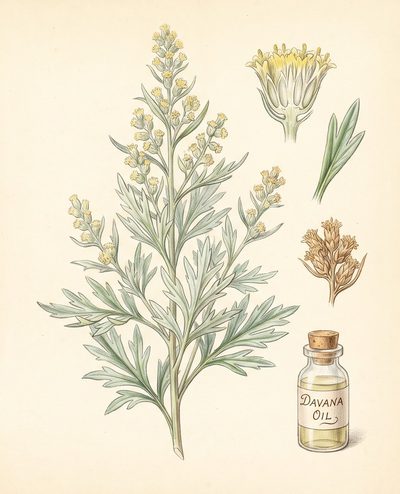 DavanaArtemisia pallens
The whole plate is in the library. The compass, Compare, the Sky of eleven hundred plants and the formulary open with an email address and a password, free, with the formula builder and its safety engine. Herbert in full, his formulating, clients, the handouts and the labels are the paid room.
Open the library, free