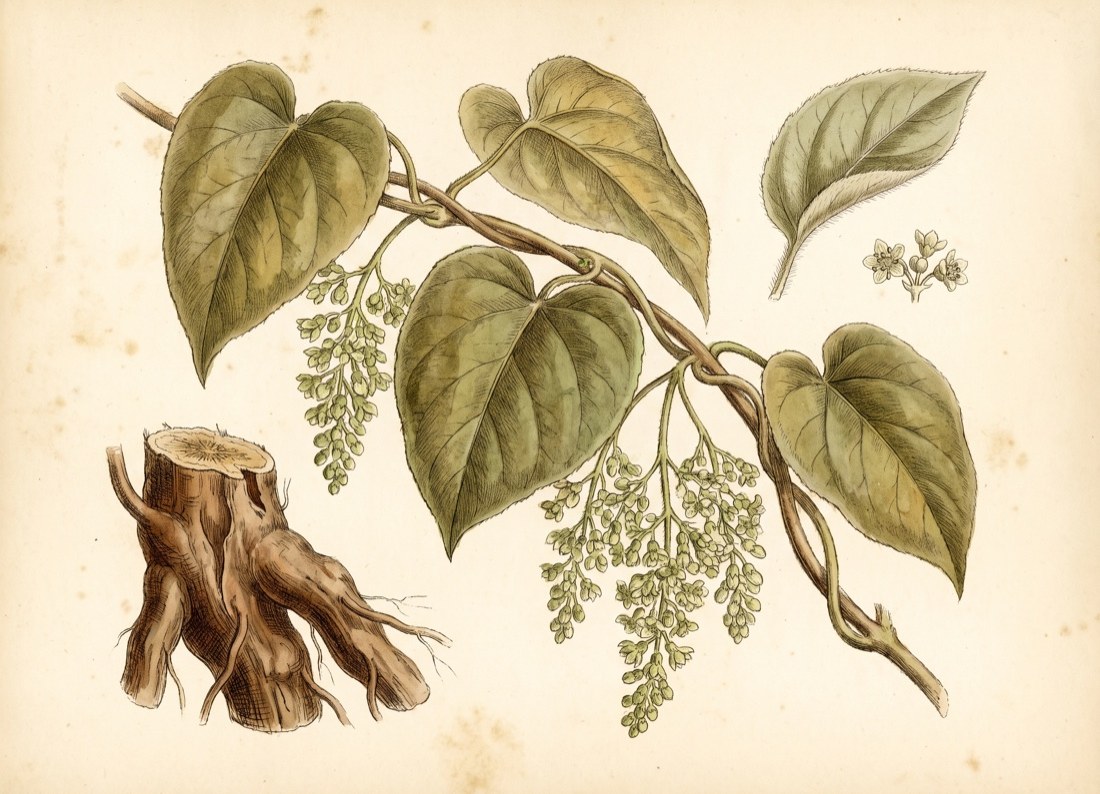
Western Herbalism
Woorari
Curare
Curare, or woorara, produces its poisonous effects only when it has penetrated into the circulation, either by means of a wound, by rectal injection, or by inhalation (Pelouze and Bernard). When applied to the skin it powerfully irritates.

Ask Herbert about Woorari. Herbert is the master herbalist inside Bountiful Herbs: he answers from this plate and eleven hundred others, with dosing, pairing and cautions. Your first ten questions are free.
Ask HerbertSafety
Recognised toxicity. This plant carries a toxicity flag in the record; it is for trained practitioners only.
Pregnancy: Not safe. Do not use in pregnancy. Curare is an arrow poison, a neuromuscular blocking extract that kills by paralysing the breathing muscles, not an herbal medicine.
Breastfeeding: Not safe. Do not use while breastfeeding. Curare is an arrow poison that paralyses the breathing muscles, not an herbal medicine.
Dosing as the sources wrote it
| Preparation | As written |
|---|---|
| Curarine, dissolved in water, with a few drops of sulphuric acid added, to facilitate its solution, is to be used in still smaller doses ... from the 1/240 to the 1/120 part of a grain. |
Doses are reproduced from the sources for practitioners and are not a recommendation for any person.
From the sources
Action, Medical Uses, and Dosage. Curare, or woorara, produces its poisonous effects only when it has penetrated into the circulation, either by means of a wound, by rectal injection, or by inhalation (Pelouze and Bernard). When applied to the skin it powerfully irritates.
Description and Chemical Composition. In appearance curare seems to differ according to its origin and its age. Sometimes it is described as a syrup, into which the points of the arrows are dipped; again, it is of a hard, resinous appearance.
Source and History. Curare is a frightfully poisonous extract, prepared by the savages of South America, for the purpose of poisoning the points of their arrows. It is known under various names, bearing a general resemblance, such as woorari, woorara, curari, cururu, ourari, wourali, etc.
Related Substances. Musculus venenosus, Mussel: Owing to the presence probably of certain ptomaines, some mussels are poisonous, or, at least, edible mussels may become occasionally toxic, as, when kept in filthy water, abounding in amoeba, bacteria, etc.
Drawn from King's American Dispensatory, 18th edition (Felter and Lloyd), and the Bountiful Herbs editorial.
Also mentioned under
Also mentioned under Nux Vomica
Nearby on the shelf
 Wood AnemoneAnemone nemorosa
 Wood appleLimonia acidissima
 Wood BetonyStachys officinalis
 Wood sorrelOxalis acetosella
 WormseedChenopodium ambrosioides
 WormwoodArtemisia absinthium
 Wu MeiPrunus mume
 Wu Wei ZiSchisandra chinensis
The whole plate is in the library. The compass, Compare, the Sky of eleven hundred plants and the formulary open with an email address and a password, free, with the formula builder and its safety engine. Herbert in full, his formulating, clients, the handouts and the labels are the paid room.
Open the library, free