Ayurvedic Herbalism
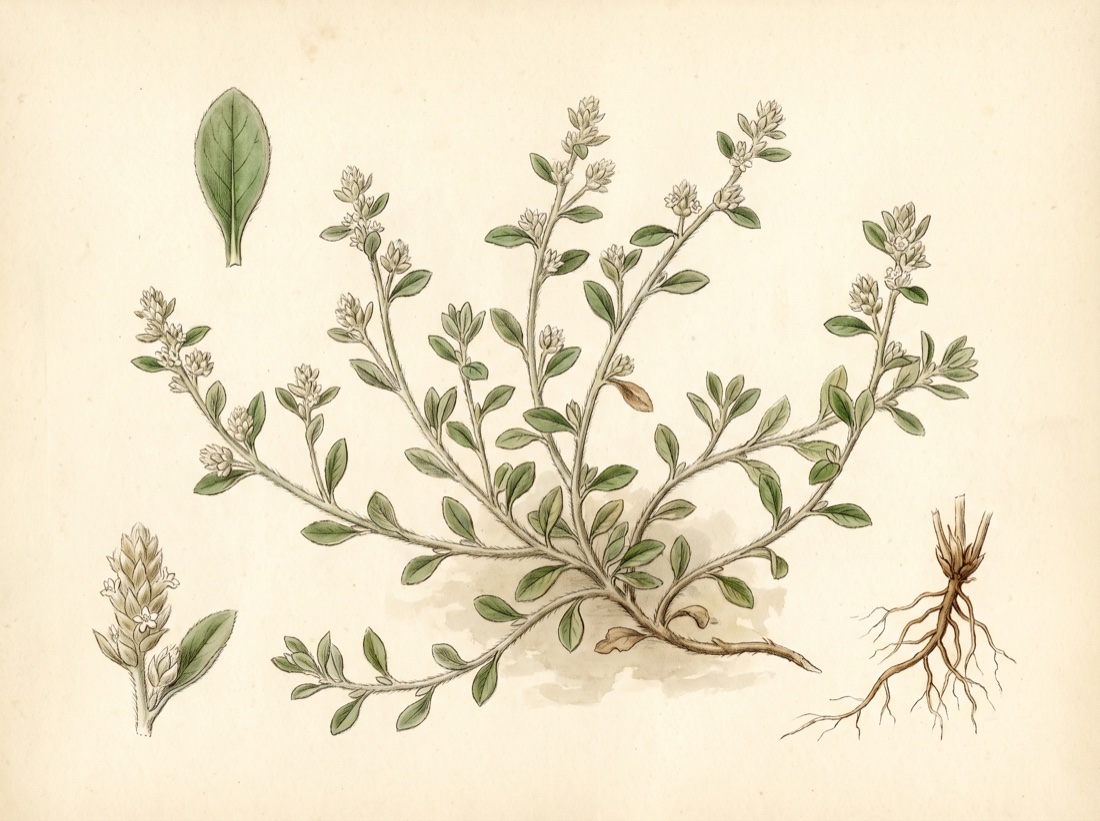
Mountain knotgrass
Aerva lanata
Also known as polpala, cherula.
Aerva lanata is a woolly, sprawling perennial of the amaranth family found on dry ground, roadsides and field margins across tropical Africa, the Arabian peninsula, India, Sri Lanka and Southeast Asia. Plants of the World Online currently places it in the genus Ouret, but almost all medical literature uses Aerva lanata. The whole plant, and especially the leafy flowering tops and root, is used in Ayurveda and Siddha as one of the plants called pashanabheda, the stone breaker, and in Sri Lanka as polpala, a household diuretic tea. It is a cooling, astringent urinary herb that combines gentle diuresis with anti-inflammatory and stone-inhibiting activity.

Ask Herbert about Mountain knotgrass. Herbert is the master herbalist inside Bountiful Herbs: he answers from this plate and eleven hundred others, with dosing, pairing and cautions. Your first ten questions are free.
Ask HerbertActions
Indications what the tradition reached for it in
- Urinary calculi and gravel
- Dysuria and burning urination
- Recurrent urinary tract infection
- Edema of renal origin
- Cough with thin sputum
- Diarrhea and dysentery
- Elevated blood sugar (traditional adjunct)
- Headache of heat type (traditional)
- Skin eruptions and boils (topical)
- Intestinal worms
Specific indications
Recurrent small kidney stones with gritty urine, low back ache and burning, in a patient who runs hot
Cystitis that keeps returning with scanty, hot, painful urination and mild swelling of the ankles
Sluggish urine flow with a sense of fullness and heat in the lower abdomen
Safety
The record lists 5 contraindications; open the plate in the library to read them in full.
In practice
Think of Aerva lanata for the hot, irritated urinary tract: burning micturition, gravel, recurrent low-grade cystitis, and the ache of small calculi trying to pass. It sits well in long courses aimed at reducing stone recurrence.
In Ayurveda
Rasa: kashaya (astringent), tikta (bitter), madhura (sweet). Virya: sheeta (cooling). Vipaka: katu (pungent). Dosha: pacifies kapha and pitta; may aggravate vata in excess.
Dosing as the sources wrote it
| Preparation | As written | Metric |
|---|---|---|
| Decoction | 10-20 g dried whole plant daily | 10000-20000 mg |
| Powder | 3-6 g dried herb twice daily | 3000-6000 mg |
| Tincture (1:5, 25%) | 3-5 mL three times daily | 3-5 mL |
Doses are reproduced from the sources for practitioners and are not a recommendation for any person.
From the sources
Overview. Aerva lanata is a woolly, sprawling perennial of the amaranth family found on dry ground, roadsides and field margins across tropical Africa, the Arabian peninsula, India, Sri Lanka and Southeast Asia. Plants of the World Online currently places it in the genus Ouret, but almost all medical literature uses Aerva lanata. The whole plant, and especially the leafy flowering tops and root, is used in Ayurveda and Siddha as one of the plants called pashanabheda, the stone breaker, and in Sri Lanka as polpala, a household diuretic tea. It is a cooling, astringent urinary herb that combines gentle diuresis with anti-inflammatory and stone-inhibiting activity.
Clinical Notes. Think of Aerva lanata for the hot, irritated urinary tract: burning micturition, gravel, recurrent low-grade cystitis, and the ache of small calculi trying to pass. It sits well in long courses aimed at reducing stone recurrence.
Ayurvedic Profile. Rasa: kashaya (astringent), tikta (bitter), madhura (sweet). Virya: sheeta (cooling). Vipaka: katu (pungent). Dosha: pacifies kapha and pitta; may aggravate vata in excess.
Nearby on the shelf
 MoringaMoringa oleifera
 MotherwortLeonurus cardiaca
 Mountain AshSorbus
 Mountain ebonyBauhinia variegata
 Mountain LaurelKalmia latifolia
 Mountain mintPycnanthemum
 MugwortArtemisia vulgaris
 Muira PuamaPtychopetalum olacoides
The whole plate is in the library. The compass, Compare, the Sky of eleven hundred plants and the formulary open with an email address and a password, free, with the formula builder and its safety engine. Herbert without limit, his formulating, clients, the handouts and the labels are the paid room.
Open the library, free