Western Herbalism
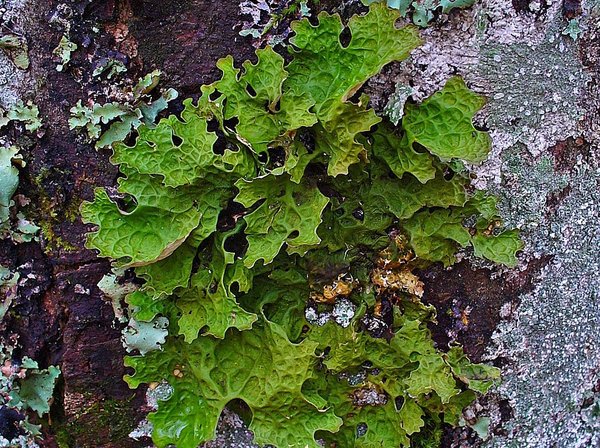
Lungwort Lichen
Lobaria pulmonaria
Also known as Tree Lungwort, Oak Lungs, Lung Moss, Sticta, Lungwort, Oak Lungwort, Lungmoss, Lung lichen.
Sticta pulmonaria, more commonly known today by its accepted lichen name Lobaria pulmonaria, is a foliose lichen that grows on the bark of old broadleaf trees in humid, undisturbed forests across the temperate northern hemisphere. Its lobed, lung-textured thallus gave rise to the old doctrine of signatures association with pulmonary disease, and the whole lichen body is the part used. It held a defined place in nineteenth century Eclectic medicine in North America, where it was prepared as a specific tincture for chronic chest complaints with a characteristic pattern of referred back and shoulder pain.

Ask Herbert about Lungwort Lichen. Herbert is the master herbalist inside Bountiful Herbs: he answers from this plate and eleven hundred others, with dosing, pairing and cautions. Your first ten questions are free.
Ask HerbertActions
Indications what the tradition reached for it in
- Chronic bronchitis and bronchial catarrh
- Cough with copious or irritated mucus
- Asthma (traditional)
- Whooping cough
- Pulmonary weakness and convalescent lung complaints
- Loss of appetite and weak digestion (bitter tonic)
- Mouth and throat inflammation (gargle)
- Wounds (topical)
- Chronic bronchitis with dry, irritable cough
- Pleuritic chest pain worsened by deep breathing
- Dull ache or soreness across the shoulders and upper back
- Referred pain from chest to the back of the neck and occiput
- Irritative cough with a sense of rawness at the base of the lungs
- Convalescence after respiratory infection with lingering chest soreness
- Nervous exhaustion accompanying chronic chest irritation
- Catarrhal conditions of the respiratory tract
Specific indications
Sharp or dull pain beneath the scapulae radiating up to the occiput
Safety
Breastfeeding: Pregnancy and lactation (limited data - use cautiously)
The record lists 3 contraindications; open the plate in the library to read them in full.
Dosing as the sources wrote it
| Preparation | As written | Metric |
|---|---|---|
| Dried lichen infusion | Dried lichen infusion: 1-2 tsp per cup, several times daily | |
| Tincture (1:5) | Tincture (1:5): 2-4 ml three times daily | 2-4 mL |
| Dose, 1/10 drop to 10 drops. | 0-0.2 mL | |
| specific sticta | The dose of specific sticta is from a fraction of a drop to 10 drops; of the powder (seldom employed), 1 to 10 grains. | 0.2 mL |
| Specific Medicine Sticta (Eclectic, Scudder's method) | 0.1-10 minims (approximately 0.006-0.6 mL), a distinct low-dose tradition not comparable to other Eclectic dosing | 0.01-0.62 mL |
| Tincture (1:5, 45%), general Eclectic dosing | 1-2 mL three times daily | 1-2 mL |
Doses are reproduced from the sources for practitioners and are not a recommendation for any person.
From the sources
Overview. Sticta pulmonaria, more commonly known today by its accepted lichen name Lobaria pulmonaria, is a foliose lichen that grows on the bark of old broadleaf trees in humid, undisturbed forests across the temperate northern hemisphere. Its lobed, lung-textured thallus gave rise to the old doctrine of signatures association with pulmonary disease, and the whole lichen body is the part used. It held a defined place in nineteenth century Eclectic medicine in North America, where it was prepared as a specific tincture for chronic chest complaints with a characteristic pattern of referred back and shoulder pain.
Clinical Notes. Eclectic physicians reached for Sticta less for acute, feverish chest disease and more for the lingering, nagging irritation that follows a bronchitis or pleurisy once the sharper inflammatory phase has passed: a dry, hacking cough, a dull soreness across the upper back and shoulders, and a pain that runs up into the base of the skull.
Action and Therapy. Sticta relieves pain and muscular soreness confined chiefly to the neck, head, and chest, and irritation in parts supplied by the vagus. Thus it proves useful in so-called subacute rheumatic pain extending from the shoulder to the base of the occiput, or in the chest walls, or the smaller joints.
Therapy. In coughs of acute bronchitis, with the indications named, it is useful; in cough, with wheezing and tightness ... asthmatic cough, with the characteristic quick, sharp pains, it. is indicated. It also influences directly the post-nasal mucosa.
Drawn from Scudder's Specific Medication and Specific Medicines; King's American Dispensatory, 18th edition (Felter and Lloyd); Ellingwood's American Materia Medica, Therapeutics and Pharmacognosy; Felter's Eclectic Materia Medica, Pharmacology and Therapeutics, and the Bountiful Herbs editorial.
Nearby on the shelf
 LophatherumLophatherum gracile
 Loquat LeafEriobotrya japonica
 LovageLevisticum officinale
 LungwortPulmonaria officinalis
 Luo Han GuoSiraitia grosvenorii
 LupinLupinus
 LycheeLitchi chinensis
 Ma huangEphedra sinica
The whole plate is in the library. The compass, Compare, the Sky of eleven hundred plants and the formulary open with an email address and a password, free, with the formula builder and its safety engine. Herbert without limit, his formulating, clients, the handouts and the labels are the paid room.
Open the library, free