Western Herbalism
Hop hornbeam
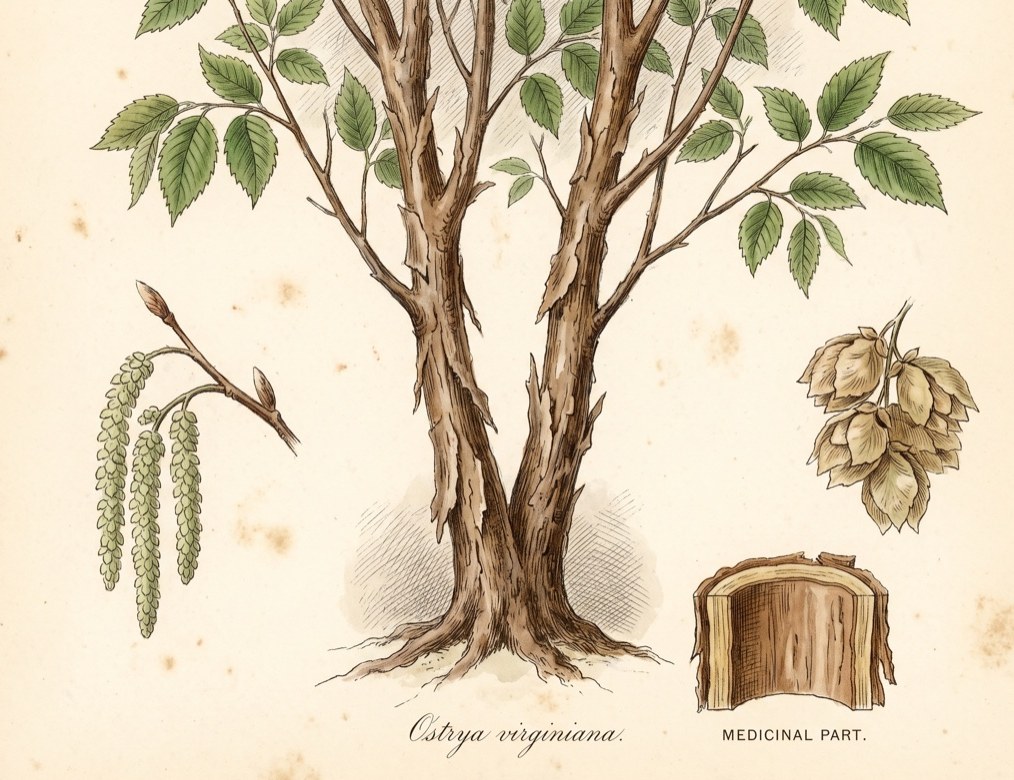
Ostrya virginica
Also known as Ironwood, Leverwood, American hop-hornbeam, Iron-wood, Lever-wood.
Ostrya virginiana, the American hop hornbeam, is a small understory tree of eastern North American woodlands, related to the hazels and birches, named for its hop-like fruiting clusters. The physiomedical and eclectic traditions used the inner bark and heartwood as a bitter, warming tonic and antiperiodic, placing it among the tissue-restoring agents given for depleted, feverish, or scrofulous constitutions. It never became a major herb of commerce and is little used today, remaining chiefly of historical interest.

Ask Herbert about Hop hornbeam. Herbert is the master herbalist inside Bountiful Herbs: he answers from this plate and eleven hundred others, with dosing, pairing and cautions. Your first ten questions are free.
Ask HerbertActions
Indications what the tradition reached for it in
- General debility with poor appetite
- Low-grade intermittent fevers
- Dyspepsia with sluggish digestion
- Scrofulous constitution with weak tissue tone
- Convalescence after prolonged illness
- Muscular weakness and wasting
- Chronic mucous discharges from atonic tissue
- Poor recovery from ague or malarial-type fevers
Specific indications
Low-grade, recurring intermittent fever in a weak, debilitated patient with poor appetite
Chronic wasting with pale, flabby, atonic tissue and slow, sluggish digestion
Safety
Pregnancy: Avoid in pregnancy due to absence of safety data rather than any known specific risk.
Breastfeeding: Avoid in lactation due to absence of safety data.
The record lists 2 contraindications; open the plate in the library to read them in full.
In practice
Nineteenth century physiomedical writers reached for hop hornbeam bark in patients whose vitality had been worn down by recurring low fevers, poor appetite, and general debility, particularly where the tissues seemed lax and atonic rather than tense or inflamed. It was classed with the slow, sustained bitter tonics rather than the sharp stimulating ones, meant to be given over weeks rather than days, often alongside other alteratives for scrofulous or wasting conditions. Preparation was traditionally as a decoction of the shaved bark or heartwood chips, simmered gently, or as a fluid extract. Because so little modern work exists on this plant, it is reasonable to treat it as a mild, food-like bitter tonic rather than a specific remedy, and to favor better-documented bitters such as gentian or barberry where a comparable action is needed with a firmer evidence base.
Dosing as the sources wrote it
| Preparation | As written | Metric |
|---|---|---|
| Decoction | 15-30 g dried inner bark or wood chips simmered gently, taken across the day | 15000-30000 mg |
| Tincture (1:5) | 2-5 mL three times daily | 2-5 mL |
| decoction | Dose of the decoction, 1 or 2 fluid ounces, 3 or 4 times a day; of the fluid extract, 1 fluid drachm. | 59.15-59.15 mL |
Doses are reproduced from the sources for practitioners and are not a recommendation for any person.
From the sources
Overview. Ostrya virginiana, the American hop hornbeam, is a small understory tree of eastern North American woodlands, related to the hazels and birches, named for its hop-like fruiting clusters. The physiomedical and eclectic traditions used the inner bark and heartwood as a bitter, warming tonic and antiperiodic, placing it among the tissue-restoring agents given for depleted, feverish, or scrofulous constitutions. It never became a major herb of commerce and is little used today, remaining chiefly of historical interest.
Clinical Notes. Nineteenth century physiomedical writers reached for hop hornbeam bark in patients whose vitality had been worn down by recurring low fevers, poor appetite, and general debility, particularly where the tissues seemed lax and atonic rather than tense or inflamed.
Properties and Uses. The bark and the inner or heart-wood of this tree are used in medicine. They are stimulating and moderately astringing, slow and permanent in action, and quite bitter. Their action is of the alterative tonic order.
Description. Natural Order, Cupuliferae. In the same family with oak, beech, and chestnut. Slender trees, with very dense and tough wood, twenty to thirty feet high, in rich woods, with a brownish and finely furrowed bark, much like the carpinus, (blue beech.) Flowers dioecious; sterile in drooping aments, of about twelve stamens in the axil of a scale-like bract, filaments somewhat united; fertile numerous in a short terminal catkin, with small deciduous bracts, the involucre enlarging so as to form a sort of bladdery sac inclosing the fruit, and a number of these forming a cone-like strobile much resembling the strobile of the hop.
Drawn from Cook's Physio-Medical Dispensatory; King's American Dispensatory, 18th edition (Felter and Lloyd), and the Bountiful Herbs editorial.
Nearby on the shelf
 Holy basilOcimum tenuiflorum
 Honduras barkCascara Amarga
 HoneysuckleLonicera japonica
 HoodiaHoodia gordonii
 HopsHumulus lupulus
 Horny Goat WeedEpimedium brevicornum
 Horse ChestnutAesculus hippocastanum
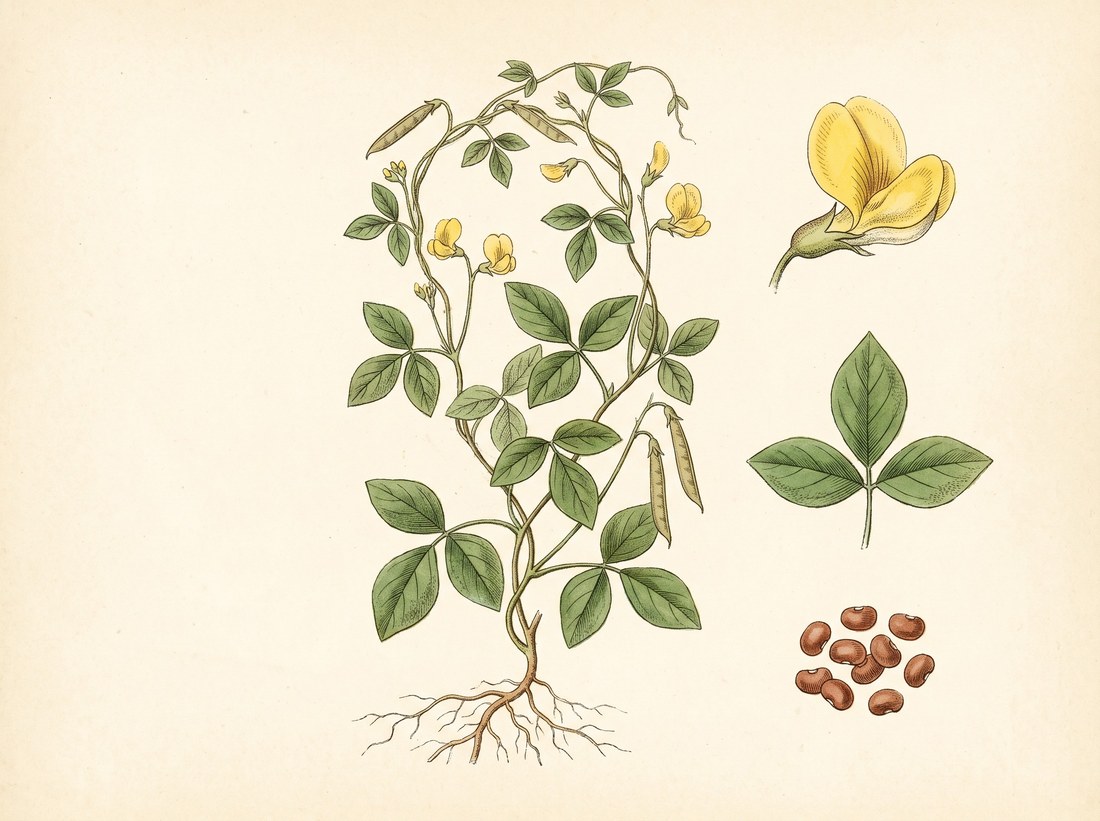 Horse gramMacrotyloma uniflorum
The whole plate is in the library. The compass, Compare, the Sky of eleven hundred plants and the formulary open with an email address and a password, free, with the formula builder and its safety engine. Herbert without limit, his formulating, clients, the handouts and the labels are the paid room.
Open the library, free