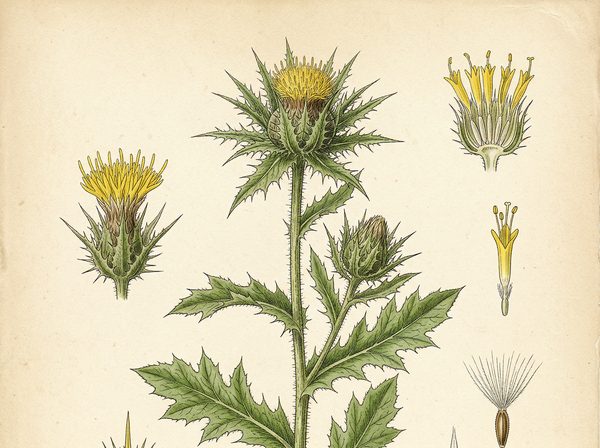
Western Herbalism
Blessed Thistle
Cnicus benedictus
Also known as Carbenia Benedicta, Carduus Benedictus, Holy thistle.
Traditional use approved by HMPC for temporary loss of appetite and mild dyspepsia (30+ years documented use in EU) approves for dyspepsia and loss of appetite GRAS as flavoring (FDA) No robust clinical trials for efficacy Preclinical data supports digestive and anti-inflammatory actions

Ask Herbert about Blessed Thistle. Herbert is the master herbalist inside Bountiful Herbs: he answers from this plate and eleven hundred others, with dosing, pairing and cautions. Your first ten questions are free.
Ask HerbertActions
Indications what the tradition reached for it in
- Loss of appetite
- Dyspepsia
- Constipation
- Mild GI spasms
- Stomach upset
- Gas
- Gallbladder disorders
- Liver disease
- Bloating
- Flatulence
- Indigestion
- Low stomach acidity
- Abdominal distension
- Colic
- Cramps
- Debility
- Digestive discomfort
- Fatigue
- Insufficient lactation
- Muscle spasms
- Weakness
- Digestive complaints
- Gallbladder dysfunction
- Poor bile flow
- Low milk supply
- Anorexia
- Flatulent dyspepsia
- Bronchial catarrh
- Topically for gangrenous
- Indolent ulcers
Safety
The record lists 2 contraindications; open the plate in the library to read them in full.
Dosing as the sources wrote it
| Preparation | As written | Metric |
|---|---|---|
| Tea | Tea (infusion): 1.5-3 g dried herb per 150-250 mL boiling water, steep 10-15 min, 2-3x/day before meals | 1500-3000 mg |
| Tincture | Tincture (1:5, 25% EtOH): 3-6 mL 3x/day | 3-6 mL |
| Liquid extract | Liquid extract (1:1, 25% EtOH): 1.5-2 mL 3x/day | 1.5-2 mL |
| Powder: 1-2 g before meals | 1000-2000 mg | |
| Total daily: 4-6 g ( | 4000-6000 mg | |
| Dried flowering tops 1.5-3.0 g as an infusion three times daily .(G6, G7) Liquid extract 1.5-3.0 mL (1 : 1 in 25% alcohol) three times daily .(G6, G7) | 1500-3000 mg |
Doses are reproduced from the sources for practitioners and are not a recommendation for any person.
From the sources
Clinical Notes. Traditional use approved by HMPC for temporary loss of appetite and mild dyspepsia (30+ years documented use in EU) approves for dyspepsia and loss of appetite GRAS as flavoring (FDA) No robust clinical trials for efficacy Preclinical data supports digestive and anti-inflammatory actions
Properties and Uses. The leaves are relaxing and slightly stimulating, and belong to the class of diaphoretic tonics, as do boneset and camomile. The warm infusion will promote mild diaphoresis, and soon procure vomiting. As with boneset, the emesis thus procured exerts a depurating action upon the liver and gall-ducts; and this infusion will promote catharsis, with a free discharge of bile.
Description. Natural Order, Compositae. Genus CENTAUREA: Annual herbs. Leaves alternate; heads radiate, involucre of many equal leaves in two series; disk sterile; rays fertile; receptacle naked; pappus wanting. C.
indications. Blessed Thistle is traditionally indicated for: Loss of appetite, Dyspepsia, Constipation, Mild GI spasms, Stomach upset, Gas, Gallbladder disorders, Liver disease, Bloating, Flatulence, Indigestion, Low stomach acidity, Abdominal distension, Colic, Cramps, and 10 further conditions.
Drawn from Cook's Physio-Medical Dispensatory; King's American Dispensatory, 18th edition (Felter and Lloyd), and the Bountiful Herbs editorial.
Nearby on the shelf
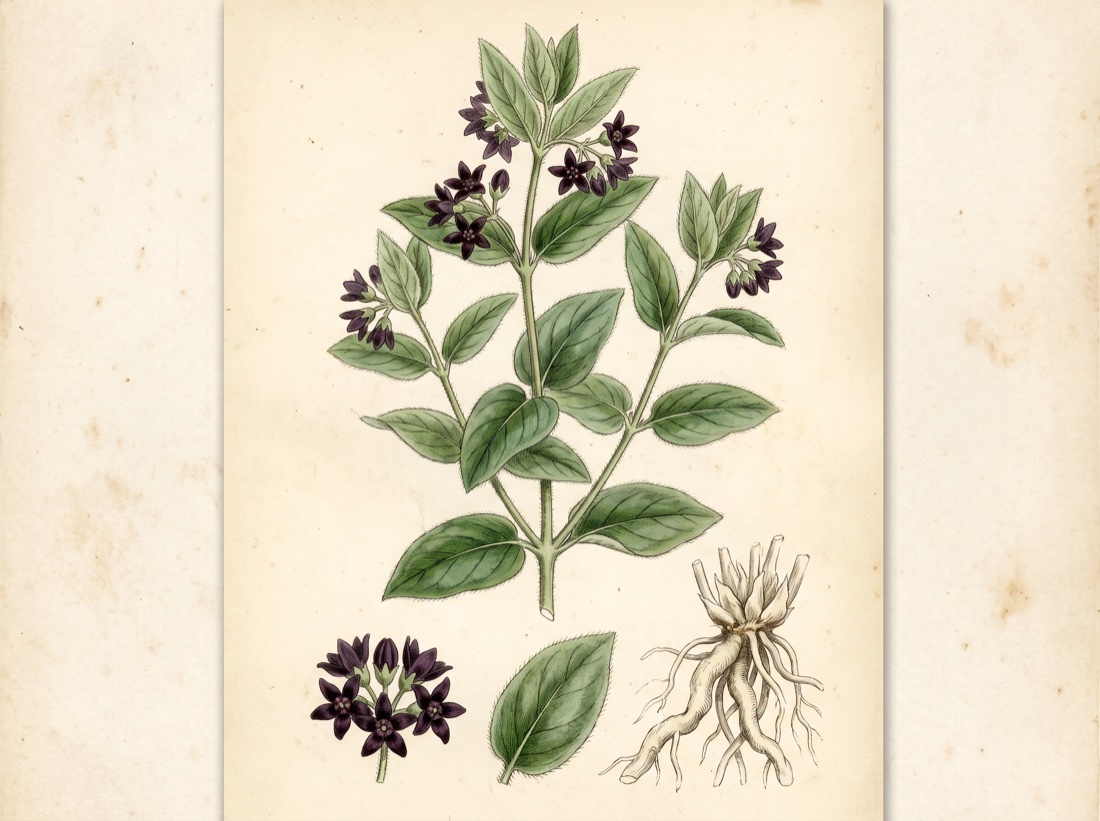 Blackend swallowwortVincetoxicum atratum
 Bladder nutStaphylea trifolia
 BladderwrackFucus vesiculosus
 Blazing StarAletris farinosa
 BletillaBletilla striata
 BloodrootSanguinaria canadensis
 Blue cohoshCaulophyllum thalictroides
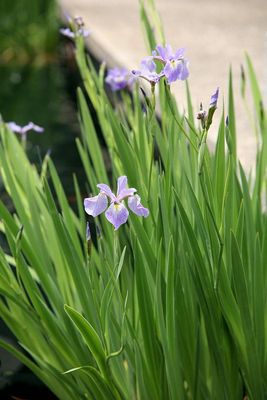 Blue flagIris versicolor
The whole plate is in the library. The compass, Compare, the Sky of eleven hundred plants and the formulary open with an email address and a password, free, with the formula builder and its safety engine. Herbert without limit, his formulating, clients, the handouts and the labels are the paid room.
Open the library, free