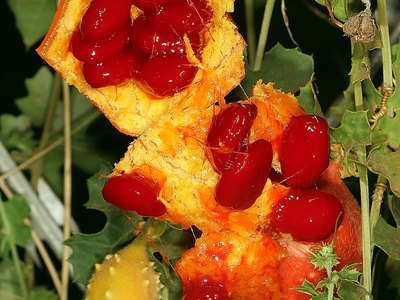
Western Herbalism
Balsam apple
Momordica balsamina
Also known as Balsam pear, African cucumber, Southern balsam pear.
Momordica balsamina is a slender annual climbing vine of the cucurbit family, cultivated as a garden ornamental and food plant for its warty, orange-ripening fruit. It grows widely in warm climates of Africa, Asia and the Americas and has been used both as a folk food and topical remedy. In nineteenth century American eclectic practice the fresh fruit, macerated in alcohol or whisky, was applied externally as a dressing for old sores, chapped hands and hemorrhoids, reflecting a broader traditional use of Momordica species as topical vulneraries across several cultures.

Ask Herbert about Balsam apple. Herbert is the master herbalist inside Bountiful Herbs: he answers from this plate and eleven hundred others, with dosing, pairing and cautions. Your first ten questions are free.
Ask HerbertActions
Indications what the tradition reached for it in
- Chapped hands
- Old sores and ulcers
- Hemorrhoids
- Minor wounds and abrasions
- Chilblains
- Skin inflammation
- Insect bites
- Cracked or fissured skin
Specific indications
Chapped, cracked hands in cold weather with dry, fissured skin that resists ordinary emollients
Slow-healing old sores or indolent ulcers with poor granulation tissue
Safety
Low dose botanical. Used in drop doses in the classical practice; not a plant to dose freely.
Pregnancy: Avoid internal use in pregnancy: related Momordica species are reputed abortifacients in folk medicine and safety data are lacking; topical use on unbroken skin is unlikely to pose risk but has not been studied.
Breastfeeding: Avoid internal use during lactation due to absence of safety data; topical use is traditional but unstudied.
The record lists 5 contraindications; open the plate in the library to read them in full.
In practice
The traditional preparation is a simple alcoholic maceration of the whole ripe fruit, applied directly to the affected skin. Eclectic writers valued it chiefly as a local dressing rather than an internal remedy, describing its effect on old, sluggish sores and on chapped or fissured hands as reliably softening and healing.
Dosing as the sources wrote it
| Preparation | As written | Metric |
|---|---|---|
| Fruit tincture (fresh ripe fruit macerated in alcohol, topical only) | applied externally to affected skin 2-3 times daily | |
| Infused oil (topical) | applied externally to chapped skin or old sores as needed | |
| Scudder (specific medication ... low-dose theory) | Of such a preparation the dose would be quite small, say commencing with one drop | 0.02-0.02 mL |
Doses are reproduced from the sources for practitioners and are not a recommendation for any person.
From the sources
Overview. Momordica balsamina is a slender annual climbing vine of the cucurbit family, cultivated as a garden ornamental and food plant for its warty, orange-ripening fruit. It grows widely in warm climates of Africa, Asia and the Americas and has been used both as a folk food and topical remedy. In nineteenth century American eclectic practice the fresh fruit, macerated in alcohol or whisky, was applied externally as a dressing for old sores, chapped hands and hemorrhoids, reflecting a broader traditional use of Momordica species as topical vulneraries across several cultures.
Clinical Notes. The traditional preparation is a simple alcoholic maceration of the whole ripe fruit, applied directly to the affected skin. Eclectic writers valued it chiefly as a local dressing rather than an internal remedy, describing its effect on old, sluggish sores and on chapped or fissured hands as reliably softening and healing.
Specific indications and reasoning. (BALBAN APPLE.) The Balsam Apple is an annual climbing plant, growu in our gardens for its fruit, which is employed in domestic practice as a vulnerary, and an applicatiou to old soros, chapped hands, piles, etc.
Drawn from Scudder's Specific Medication and Specific Medicines, and the Bountiful Herbs editorial.
Nearby on the shelf
 BalaSida cordifolia
 Balloon Flower RootPlatycodon grandiflorus
 Balm of GileadPopulus balsamifera
 BalmonyChelone glabra
 Balsam firAbies balsamea
 Balsam of PeruMyrospermum peruiferum
 Balsam of PeruBalsamum Peruvianum
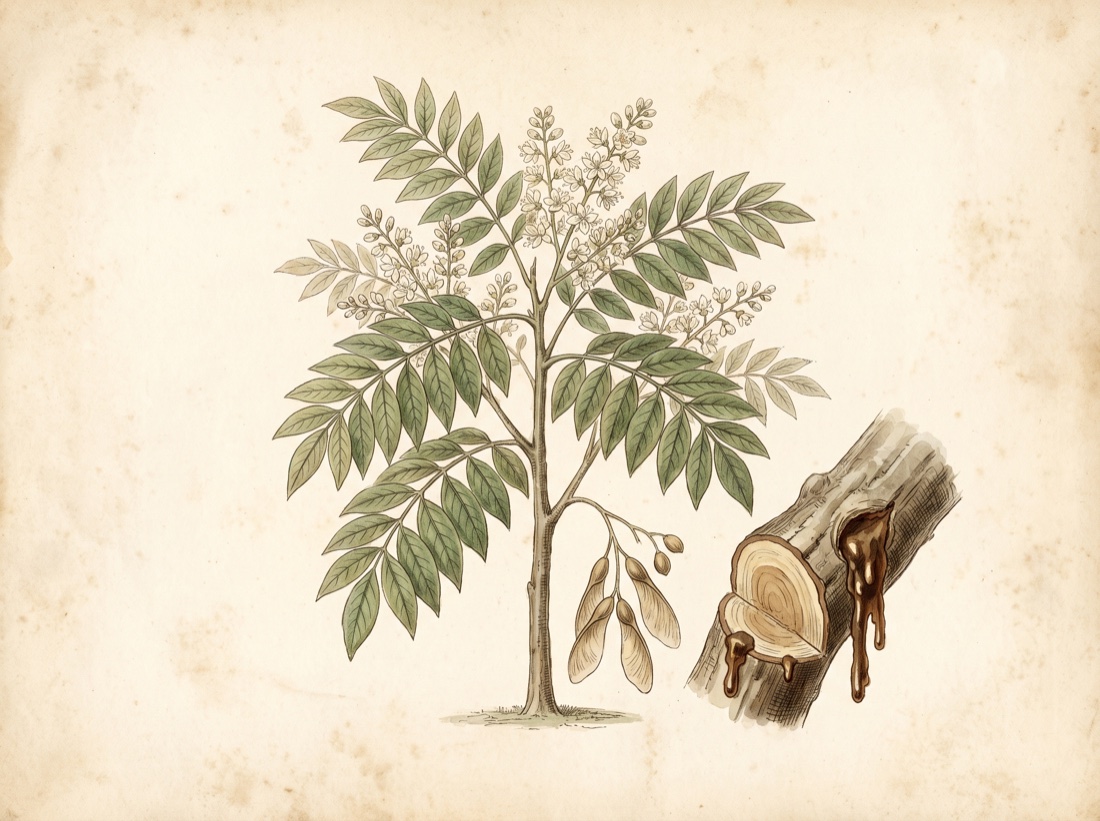 Balsam of ToluBalsamum Tolutanum
The whole plate is in the library. The compass, Compare, the Sky of eleven hundred plants and the formulary open with an email address and a password, free, with the formula builder and its safety engine. Herbert without limit, his formulating, clients, the handouts and the labels are the paid room.
Open the library, free