Ayurvedic Herbalism
Large caltrops
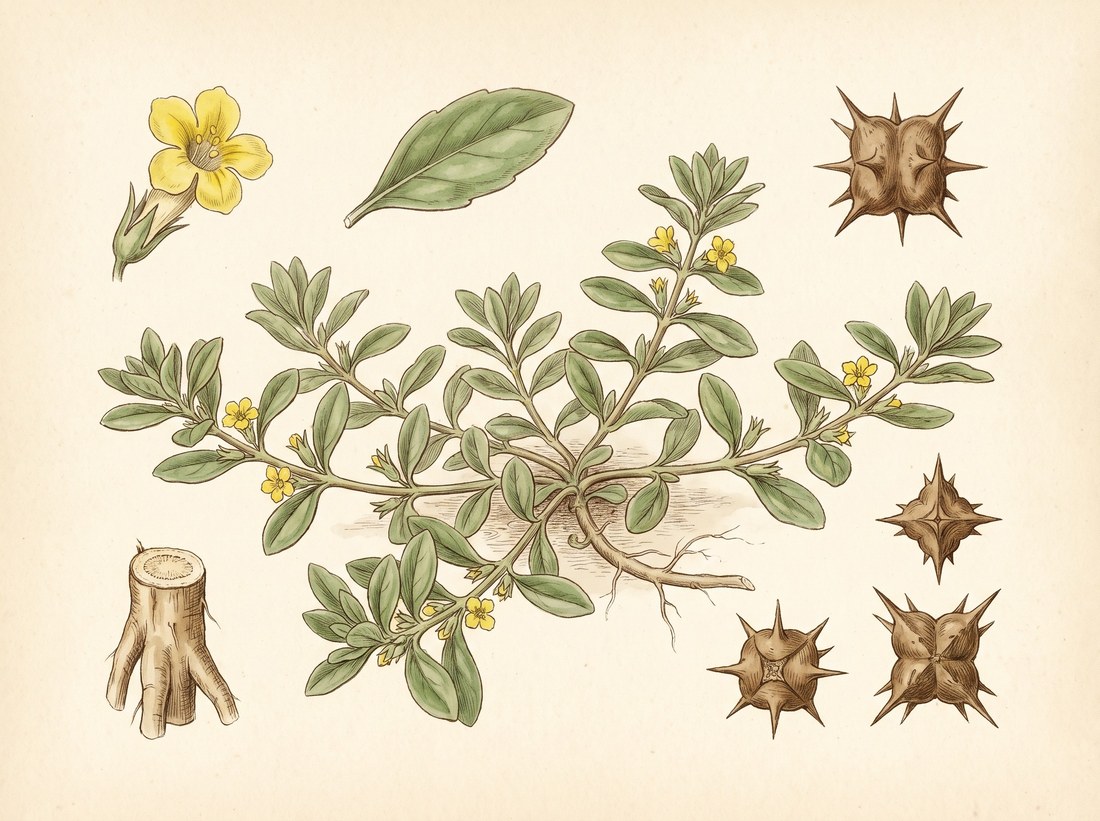
Pedalium murex
Also known as big caltrops, burra gokhru, large gokhru, Gokshuru, Brihat gokshura, Mahagokshura.
Pedalium murex is a low, fleshy annual of sandy coasts and dry wasteland across peninsular India, Sri Lanka and tropical Africa, whose four angled fruits carry sharp spines much larger than those of Tribulus. Ayurveda treats it as Brihat Gokshura, the large caltrop, a heavier, slimier and more cooling counterpart of Tribulus terrestris used for the same urinary and reproductive complaints, and the two are often confused or interchanged in trade. Its leaves and stems, agitated in water, yield a mucilage that is the plant's most distinctive medicine.

Ask Herbert about Large caltrops. Herbert is the master herbalist inside Bountiful Herbs: he answers from this plate and eleven hundred others, with dosing, pairing and cautions. Your first ten questions are free.
Ask HerbertActions
Indications what the tradition reached for it in
- Burning, painful urination
- Urethritis and urethral discharge (adjunct)
- Urinary gravel and small stones
- Recurrent cystitis with irritation
- Nocturnal emission and spermatorrhea (traditional)
- Low libido and erectile weakness
- Male subfertility with poor sperm quality
- Leukorrhea with burning
- Edema with scanty urine
- Type 2 diabetes (adjunct, traditional)
- Urinary irritation in the elderly
Specific indications
Scalding, frequent, scanty urination with a raw feeling in the urethra, where a thick cold mucilaginous drink soothes within hours
The young man with nocturnal emissions, urinary burning and fatigue in whom the tradition sees pitta disturbing the reproductive tissue
Recurrent urinary gravel with dysuria in a hot patient who does not tolerate warming diuretics
Leukorrhea with burning and low back ache in a thin, dry, anxious woman
Safety
The record lists 7 contraindications; open the plate in the library to read them in full.
In practice
Brihat Gokshura is chosen over Tribulus when the urinary complaint is dominated by burning and rawness rather than by obstruction or stones alone. The classical form is the sheeta kashaya: a handful of fresh leaves and stems is stirred vigorously in a glass of water until the water turns slimy, and this is drunk once or twice daily for dysuria, urethritis and gonorrheal discharge.
In Ayurveda
Rasa: madhura (sweet), tikta (bitter). Virya: sheeta (cooling). Vipaka: madhura (sweet). Guna: guru (heavy), snigdha (unctuous), picchila (slimy). Dosha: pacifies vata and pitta; may increase kapha in excess. Karma: mutrala (diuretic); mutravirechaniya (promotes urine flow); ashmarighna (breaks and expels urinary stones); vrishya (aphrodisiac); balya (strengthening); shukrala (increases semen); dahaprashamana (relieves burning); shothahara (reduces swelling); vatapittahara (pacifies vata and pitta); brimhana (nourishing). Classical indications: mutrakrichra (dysuria); ashmari (urinary calculi); mutraghata (urinary retention); prameha (urinary disorders including diabetes); shukrameha (spermatorrhea); klaibya (male sexual dysfunction); daha (burning sensation); shotha (edema); puyameha (purulent urethral discharge); shvetapradara (leukorrhea); daurbalya (weakness). The dried spiny fruit is the main drug, given as churna, as kwatha, and most characteristically as a cold infusion or mucilage: the fresh leaves and stems stirred in water yield a thick slimy drink taken for dysuria and gonorrheal discharge. The plant is used interchangeably with, or as the larger variety of, Tribulus in Gokshura formulations. Classical formulations: Gokshura churna (brihat variety), Gokshuradi guggulu (as substitute), Gokshuradi kwatha, Brihat gokshura sheeta kashaya (cold infusion), Gokshuradi churna. Described in: Bhavaprakasha Nighantu, Raja Nighantu, Kaiyadeva Nighantu, Dhanvantari Nighantu.
Dosing as the sources wrote it
| Preparation | As written | Metric |
|---|---|---|
| Churna | 3-6 g fruit powder twice daily with milk or water | 3000-6000 mg |
| Kwatha | 50-100 mL fruit decoction twice daily | 50-100 mL |
| Sheeta kashaya (cold mucilage) | 100-200 mL cold infusion of fresh leaf and stem once or twice daily | 100-200 mL |
| Ksheerapaka | 100-200 mL milk decoction once daily at bedtime | 100-200 mL |
Doses are reproduced from the sources for practitioners and are not a recommendation for any person.
From the sources
Overview. Pedalium murex is a low, fleshy annual of sandy coasts and dry wasteland across peninsular India, Sri Lanka and tropical Africa, whose four angled fruits carry sharp spines much larger than those of Tribulus. Ayurveda treats it as Brihat Gokshura, the large caltrop, a heavier, slimier and more cooling counterpart of Tribulus terrestris used for the same urinary and reproductive complaints, and the two are often confused or interchanged in trade. Its leaves and stems, agitated in water, yield a mucilage that is the plant's most distinctive medicine.
Clinical Notes. Brihat Gokshura is chosen over Tribulus when the urinary complaint is dominated by burning and rawness rather than by obstruction or stones alone. The classical form is the sheeta kashaya: a handful of fresh leaves and stems is stirred vigorously in a glass of water until the water turns slimy, and this is drunk once or twice daily for dysuria, urethritis and gonorrheal discharge.
Ayurvedic Profile. Rasa: madhura (sweet), tikta (bitter). Virya: sheeta (cooling). Vipaka: madhura (sweet). Guna: guru (heavy), snigdha (unctuous), picchila (slimy). Dosha: pacifies vata and pitta; may increase kapha in excess.
Nearby on the shelf
 Lady's MantleAlchemilla vulgaris
 Lady's SlipperCypripedium pubescens
 LadybellsAdenophora stricta
 LaminariaLaminaria
 Large-fruited elmUlmus macrocarpa
 Large-leaf gentianGentiana macrophylla
 LavenderLavandula spp.
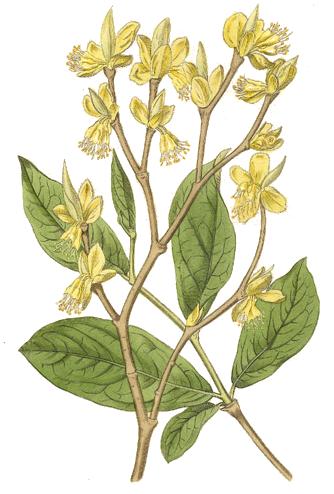 LeatherwoodDirca
The whole plate is in the library. The compass, Compare, the Sky of eleven hundred plants and the formulary open with an email address and a password, free, with the formula builder and its safety engine. Herbert without limit, his formulating, clients, the handouts and the labels are the paid room.
Open the library, free