Western Herbalism
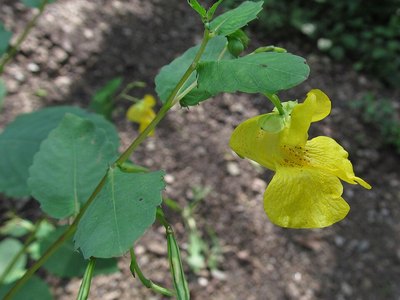
Jewelweed
Impatiens pallida
Also known as Pale jewelweed, Yellow jewelweed, Balsam, Touch-me-not, Weathercocks, Snapweed, Jewel-weed, Balsam jewel Weed.
Impatiens pallida, pale or yellow jewelweed, is a soft, succulent annual native to moist, shaded woodlands and streambanks of eastern North America, closely related to the more familiar orange jewelweed Impatiens capensis. Its translucent, amber-colored, juice-filled stems have long been prized as a topical folk remedy for poison ivy dermatitis and other itchy or fungal skin complaints. Physiomedicalist practitioners such as Cook also used an infusion of the fresh plant internally as a gentle relaxant diuretic said to act on the kidneys and gall-ducts, though this internal use has largely fallen out of favor.

Ask Herbert about Jewelweed. Herbert is the master herbalist inside Bountiful Herbs: he answers from this plate and eleven hundred others, with dosing, pairing and cautions. Your first ten questions are free.
Ask HerbertActions
Indications what the tradition reached for it in
- Poison ivy or poison oak contact dermatitis
- Insect bites and stings
- Nettle rash and hives
- Athlete's foot and other superficial fungal skin infections
- Minor cuts, scrapes, and bruises
- Traditional use for jaundice
- Traditional use for dropsy and edema
- Hemorrhoids (topical)
- Itchy eczematous skin eruptions
- Warts (folk use)
Specific indications
Vesicular, intensely itching dermatitis from recent poison ivy or poison oak contact, applied fresh and as soon as possible after exposure
Scaling, itchy fungal eruption between the toes or on damp skin folds
Safety
Low dose botanical. Used in drop doses in the classical practice; not a plant to dose freely.
Pregnancy: Avoid internal use in pregnancy, as safety data are lacking; topical use on unbroken skin is considered low risk.
Breastfeeding: Avoid internal use during lactation given the absence of safety data; topical use is unlikely to be problematic.
The record lists 3 contraindications; open the plate in the library to read them in full.
In practice
The main modern use of jewelweed is topical: the fresh stem is crushed or bruised and the juice rubbed directly onto skin that has just brushed against poison ivy or poison oak, on the theory that prompt application helps limit the itching and vesicular reaction that follows urushiol exposure.
Dosing as the sources wrote it
| Preparation | As written | Metric |
|---|---|---|
| Fresh plant juice (topical) | apply crushed fresh stem juice directly to affected skin, repeat as needed | |
| Fresh plant tincture (1:2, 60%) | topical application to skin, or 1-2 mL up to three times daily internally (traditional, short term) | 1-2 mL |
| Infusion (traditional internal use) | 1-2 g fresh or dried herb as infusion, once daily | 1000-2000 mg |
Doses are reproduced from the sources for practitioners and are not a recommendation for any person.
From the sources
Overview. Impatiens pallida, pale or yellow jewelweed, is a soft, succulent annual native to moist, shaded woodlands and streambanks of eastern North America, closely related to the more familiar orange jewelweed Impatiens capensis. Its translucent, amber-colored, juice-filled stems have long been prized as a topical folk remedy for poison ivy dermatitis and other itchy or fungal skin complaints. Physiomedicalist practitioners such as Cook also used an infusion of the fresh plant internally as a gentle relaxant diuretic said to act on the kidneys and gall-ducts, though this internal use has largely fallen out of favor.
Clinical Notes. The main modern use of jewelweed is topical: the fresh stem is crushed or bruised and the juice rubbed directly onto skin that has just brushed against poison ivy or poison oak, on the theory that prompt application helps limit the itching and vesicular reaction that follows urushiol exposure.
Action and Therapy. External. Refrigerant and sedative. The fresh juice of the crushed Impatiens gives prompt relief in the dermatitis of rhus poisoning if used early. It also quickly relieves the intolerable stinging produced by nettles. As these plants usually grow contiguously the balsam can be procured and applied at once. The relief is almost magical. The bruised plants may also be used to relieve the pain of acute engorged hemorrhoids.
Properties and Uses. This plant is a relaxant, with a full share of stimulating properties, an infusion acting somewhat promptly. It influences the kidneys, gall-ducts, and bowels; and has been well spoken of by Rafinesque and Bigelow in jaundice and dropsy, but is probably too feeble to effect much.
Drawn from Cook's Physio-Medical Dispensatory; King's American Dispensatory, 18th edition (Felter and Lloyd); Felter's Eclectic Materia Medica, Pharmacology and Therapeutics, and the Bountiful Herbs editorial.
Nearby on the shelf
 JatamansiNardostachys jatamansi
 JatobaHymenaea courbaril
 Java bruceaBrucea javanica
 JeevakMalaxis acuminata
 Ji Xue TengSpatholobus suberectus
 JiaogulanGynostemma pentaphyllum
 Jimson weedDatura stramonium
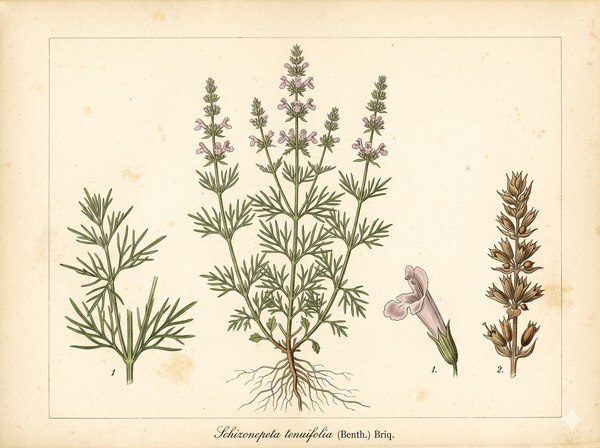 Jing JieSchizonepeta tenuifolia
The whole plate is in the library. The compass, Compare, the Sky of eleven hundred plants and the formulary open with an email address and a password, free, with the formula builder and its safety engine. Herbert without limit, his formulating, clients, the handouts and the labels are the paid room.
Open the library, free