Western Herbalism
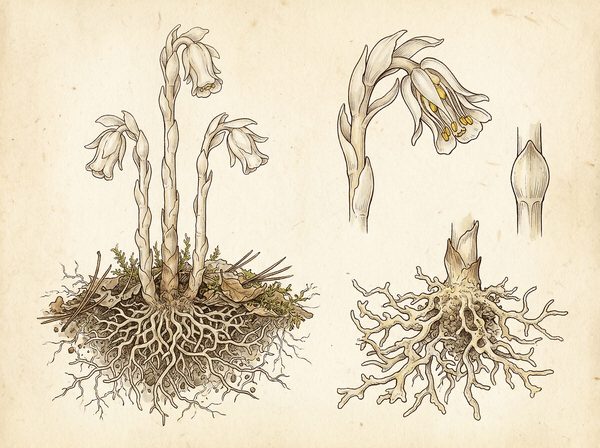
Ghost Pipe
Monotropa uniflora
Also known as Indian Pipe, Ice-plant, Bird's nest, Fit-plant, Ova-ova, Pipe-plant, etc.
Ice-plant root is a tonic, sedative, nervine, and antispasmodic. It has also been employed in febrile diseases, as a sedative and diaphoretic. The powder has been employed in instances of restlessness, pains, nervous irritability, etc., as a substitute for opium, without any deleterious influences.

Ask Herbert about Ghost Pipe. Herbert is the master herbalist inside Bountiful Herbs: he answers from this plate and eleven hundred others, with dosing, pairing and cautions. Your first ten questions are free.
Ask HerbertActions
Indications what the tradition reached for it in
- Chorea
- Epileptic convulsions
- Intermittent fevers
- Spasmodic affections
- Lung deficiency
- Pain
- Gonorrhea
- Epilepsy
- Nervous irritability
- Ophthalmic inflammation
- Restlessness
- Ulcers
- Cough
- Remittent fevers
- Febrile diseases
- Convulsions of children
- Skin sores
- Fever
- Ulceration of the bladder
- Inflammation of the bladder
- Anxiety
- Colic
- Cramps
- Debility
- Fatigue
- Insomnia
- Muscle spasms
- Nervous tension
- Stress
- Weakness
Safety
Pregnancy: Caution. Use with care in pregnancy (our record's flag)
Breastfeeding: Caution. Use with care while breastfeeding (our record's flag)
The record lists 6 contraindications; open the plate in the library to read them in full.
Dosing as the sources wrote it
| Preparation | As written |
|---|---|
| Powdered root, ½ to 1 drachm 2-3 times daily | |
| powdered root | Dose of the powdered root, from ½ to 1 drachm, 2 or 3 times a day. |
| This plant is undoubtedly one of value, and deserving of more confidence and attention than is at present bestowed upon it. It is, however, seldom or never used at the present day. It is not the Mesembryanthemum crystallignon (see Ficus, p. 891), or Ice-plant of Europe, which has a creeping stem a foot or more in length, with large, ovate, wavy, frosted leaves, and white flowers |
Doses are reproduced from the sources for practitioners and are not a recommendation for any person.
From the sources
Action, Medical Uses, and Dosage. Ice-plant root is a tonic, sedative, nervine, and antispasmodic. It has also been employed in febrile diseases, as a sedative and diaphoretic. The powder has been employed in instances of restlessness, pains, nervous irritability, etc., as a substitute for opium, without any deleterious influences.
Botanical Source and Description. This plant has a dark-colored, fibrous, perennial root, matted in masses about as large as a chestnut-burr, from which arise one or more short, ivory-white stems, 4 to 8 inches high, furnished with sessile, lanceolate, white, semi-transparent, approximate leaves or bracts, and bearing a large, white, terminal, solitary flower, which is at first nodding, but becomes upright in fruit.
History and Chemical Composition. This is a singular plant, found in various parts of the Union from Maine to Carolina, and westward to Missouri, growing in shady, solitary woods, in rich, moist soil, or soil composed, of decayed wood and leaves, and near the base of trees, on whose roots it is said to be parasitic.
Specific indications and reasoning. (IcE PLANT.) Will some of our subscribers prepare a tincture from the Ice-plant, and test it in the cases named in the Dispensatory. We especially want to know its influence upon the nervous system, and its action as a sedative. It is claimed to be remedial in convulsions, epilepsy, chorea, etc.
Drawn from Scudder's Specific Medication and Specific Medicines; King's American Dispensatory, 18th edition (Felter and Lloyd), and the Bountiful Herbs editorial.
Nearby on the shelf
 GentianGentiana lutea
 German chamomileMatricaria recutita
 GeumGeum
 GingerZingiber officinale
 GinsengPanax ginseng
 GlasswortSalicornia europaea
 GlehniaGlehnia littoralis
The whole plate is in the library. The compass, Compare, the Sky of eleven hundred plants and the formulary open with an email address and a password, free, with the formula builder and its safety engine. Herbert in full, his formulating, clients, the handouts and the labels are the paid room.
Open the library, free