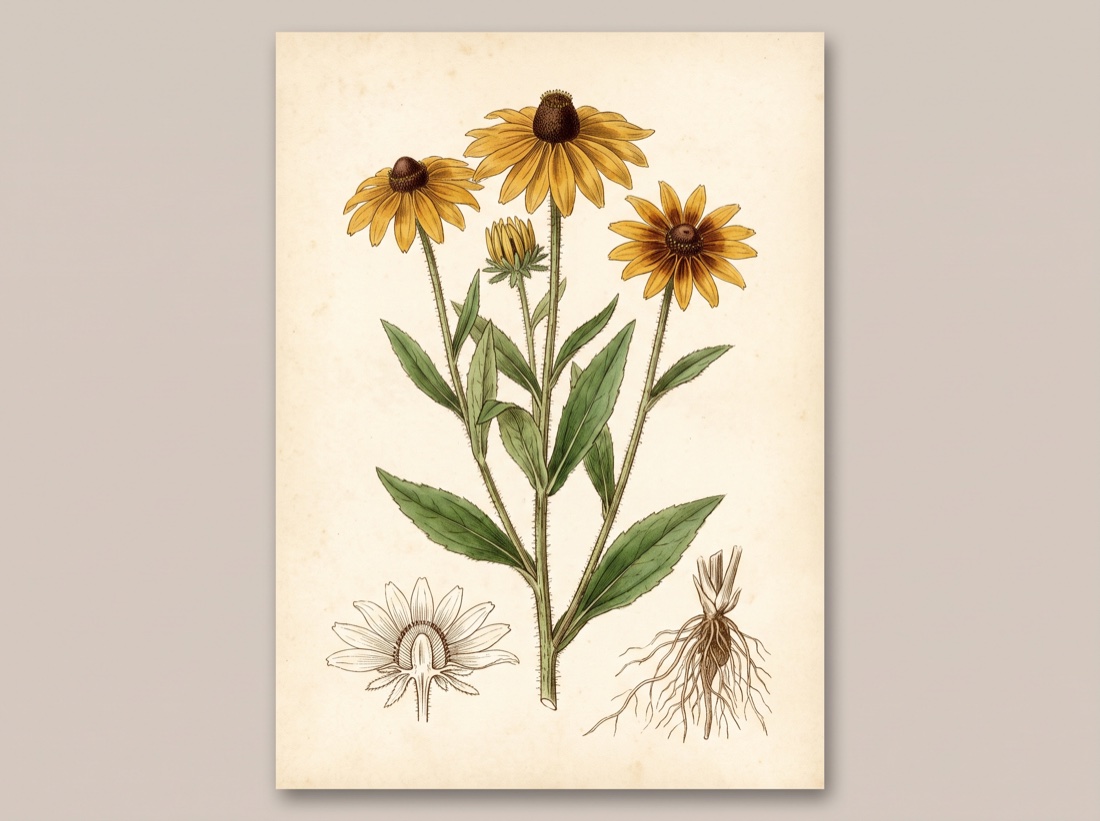
Western Herbalism
Black-eyed Susan
Rudbeckia hirta
Also known as brown-eyed Susan, hairy coneflower, yellow daisy, gloriosa daisy (garden forms), brown Betty.
Black-eyed Susan is the familiar golden daisy of North American meadows, roadsides and prairies, a short-lived perennial native to the central and eastern United States and now naturalized across the continent. It is a relative of echinacea in the coneflower group, and its root, leaves and flowers were used by Cherokee, Ojibwe, Potawatomi and other First Nations as a root tea for worms and colds, a wash for sores, snakebite and swelling, and drops for earache. Modern herbal use is small and largely follows those records, treating it as a milder local substitute for echinacea.

Ask Herbert about Black-eyed Susan. Herbert is the master herbalist inside Bountiful Herbs: he answers from this plate and eleven hundred others, with dosing, pairing and cautions. Your first ten questions are free.
Ask HerbertActions
Indications what the tradition reached for it in
- Early colds and upper respiratory infections (traditional)
- Minor wounds, sores and abrasions (topical wash)
- Snakebite and insect bites (traditional topical wash)
- Intestinal worms in children (traditional root tea)
- Edema and dropsy (traditional)
- Earache (traditional, juice of the root)
- Sore or inflamed eyes (traditional wash)
- Skin inflammation and eczema (topical)
- Colitis (experimental)
Specific indications
A stand-in for echinacea at the first sign of a cold when echinacea is unavailable, unaffordable, or not tolerated
Superficial sores, scrapes and bites cleaned with a strong decoction of the root
Safety
The record lists 4 contraindications; open the plate in the library to read them in full.
In practice
There is little clinical tradition to draw on beyond the ethnobotanical record, so the herb is best understood as a modest, safe, locally available immune and wound herb rather than a specific. Where it earns a place is in bioregional practice: a gardener or forager with a patch of black-eyed Susan and no echinacea can use the root in the same way, as a decoction or fresh root tincture at the first scratchy throat of a cold, and as an external wash for cuts, bites and slow-healing sores.
Dosing as the sources wrote it
| Preparation | As written | Metric |
|---|---|---|
| Decoction of root | 2-4 g dried root daily | 2000-4000 mg |
| Tincture (1:5, 45%) | 1-3 mL three times daily | 1-3 mL |
| External wash | 10 g dried root simmered in 500 mL water applied twice daily | 10000-10000 mg |
Doses are reproduced from the sources for practitioners and are not a recommendation for any person.
From the sources
Overview. Black-eyed Susan is the familiar golden daisy of North American meadows, roadsides and prairies, a short-lived perennial native to the central and eastern United States and now naturalized across the continent. It is a relative of echinacea in the coneflower group, and its root, leaves and flowers were used by Cherokee, Ojibwe, Potawatomi and other First Nations as a root tea for worms and colds, a wash for sores, snakebite and swelling, and drops for earache. Modern herbal use is small and largely follows those records, treating it as a milder local substitute for echinacea.
Clinical Notes. There is little clinical tradition to draw on beyond the ethnobotanical record, so the herb is best understood as a modest, safe, locally available immune and wound herb rather than a specific. Where it earns a place is in bioregional practice: a gardener or forager with a patch of black-eyed Susan and no echinacea can use the root in the same way, as a decoction or fresh root tincture at the first scratchy throat of a cold, and as an external wash for cuts, bites and slow-healing sores.
Nearby on the shelf
 Black spruceAbies Nigra
 Black teaCamellia sinensis
 Black walnutJuglans nigra
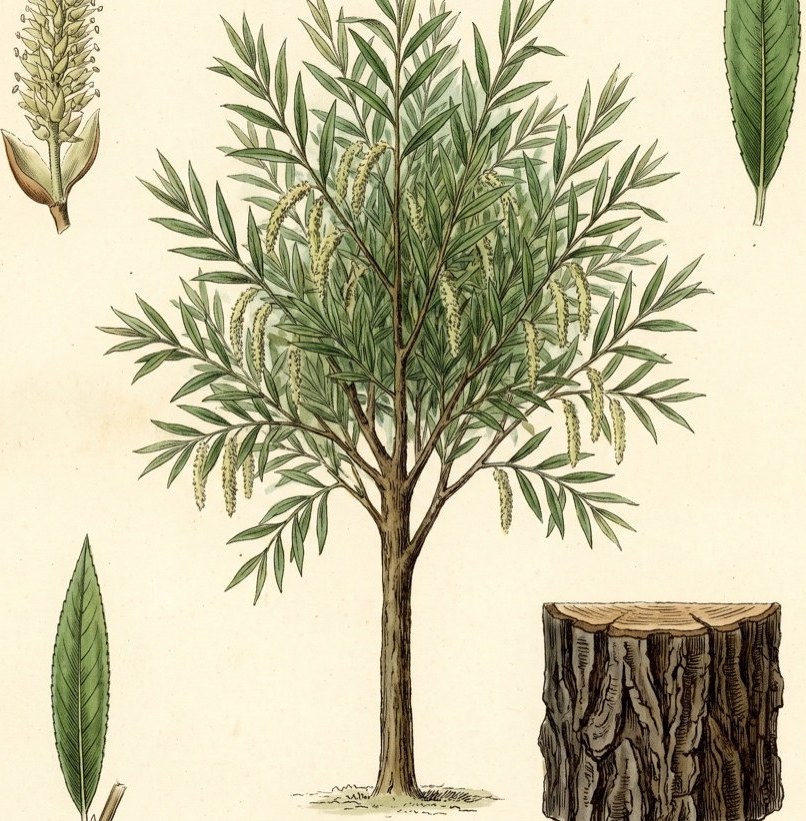 Black willowSalix Nigra
 BlackberryRubus villosus
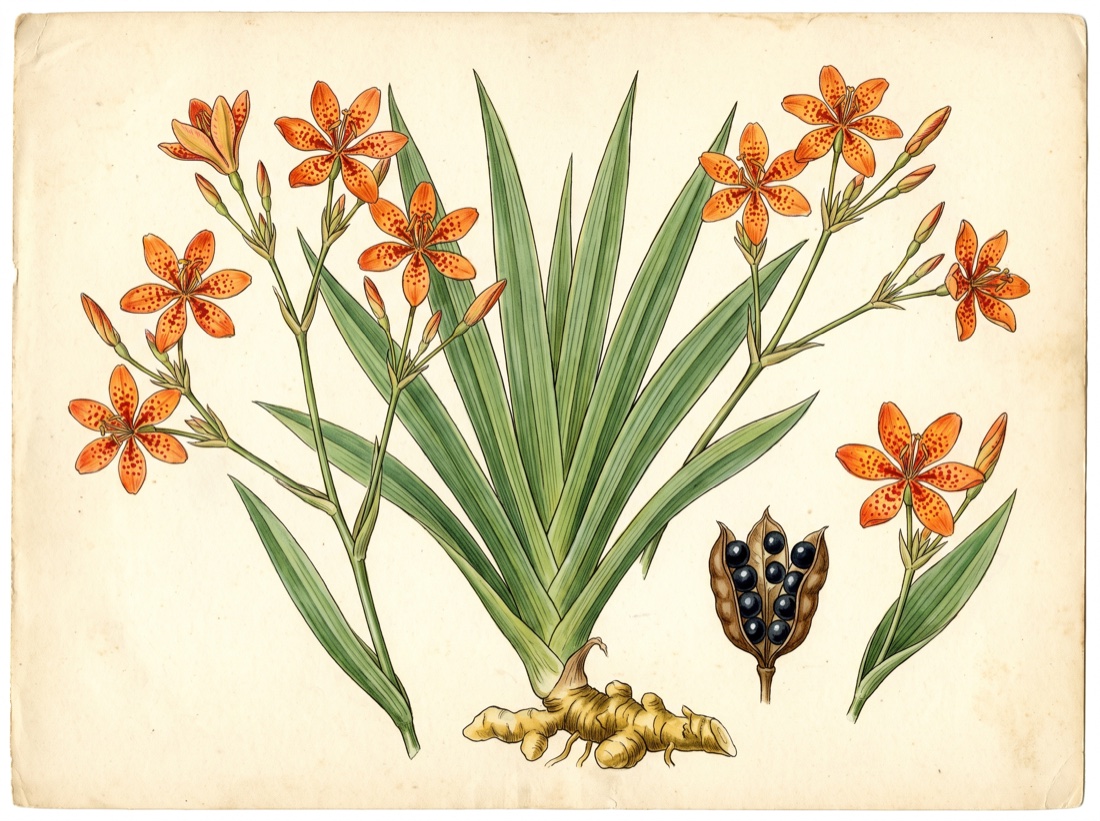 Blackberry lilyIris domestica
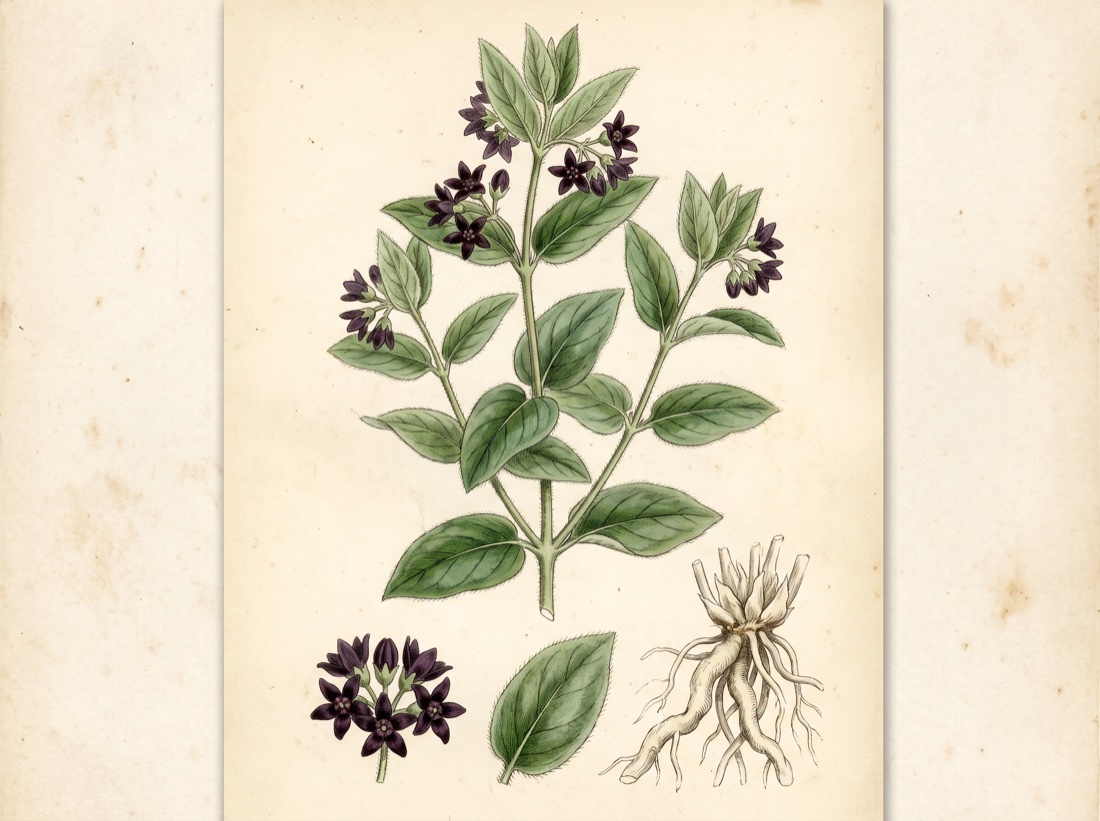 Blackend swallowwortVincetoxicum atratum
 Bladder nutStaphylea trifolia
The whole plate is in the library. The compass, Compare, the Sky of eleven hundred plants and the formulary open with an email address and a password, free, with the formula builder and its safety engine. Herbert without limit, his formulating, clients, the handouts and the labels are the paid room.
Open the library, free